
RENTAL PROPERTY TAX 2026
A 2026 tax-season guide to rental income, deductible expenses, depreciation, losses, and IRS reporting
Key takeaways
- Rental income is generally taxable and commonly reported on Schedule E (Form 1040), though the right form can depend on the services provided and the nature of the activity.
- Ordinary and necessary rental expenses may be deductible, including common costs such as advertising, insurance, repairs, taxes, mortgage interest, utilities, and management fees.
- The cost of a rental building is generally recovered through depreciation; land is not depreciable. Residential rental buildings commonly use a 27.5-year recovery period under MACRS.
- Personal use, below-market rental to relatives, passive-loss rules, and property improvements can materially change the result. Keep complete records and get advice for fact-specific situations.
IRS source: Publication 527, Residential Rental Property (2025)
What counts as rental income?
Rental income generally includes amounts received for the use or occupation of property. It is broader than the monthly rent check. Advance rent, amounts paid to cancel a lease, and certain expenses paid by a tenant on the owner’s behalf can be rental income. A security deposit is generally not income when the owner expects to return it, but it may become income if it is retained because a tenant breaks a lease or damages the property. The timing of income can also depend on the taxpayer’s accounting method.
For a typical long-term residential rental with no significant tenant services, income and expenses are generally reported on Schedule E. The IRS instructions explain that significant services, such as maid service, can change the reporting treatment; standard services such as heat, light, common-area cleaning, and trash collection do not alone count as significant services. Owners should not assume every short-term or service-heavy rental belongs on Schedule E.
IRS source: 2025 Instructions for Schedule E (Form 1040)
Common deductible rental expenses
The IRS describes many expenses of renting property as deductible from rental income when they are ordinary and necessary for the rental activity. Common examples include advertising, auto and travel expenses that meet the applicable rules, cleaning and maintenance, commissions, insurance, legal and professional fees, mortgage interest, property-management fees, repairs, supplies, real estate taxes, utilities, and depreciation. The fact that a cost is paid during the year is not the only test: the expense must relate to the rental activity and must be documented.
Repairs and improvements are a crucial distinction. A repair typically keeps the property in efficient operating condition, while an improvement may better, restore, or adapt property and may need to be capitalized and recovered over time rather than immediately deducted. Replacing a small broken component and renovating an entire kitchen are not automatically treated the same way. Preserve invoices, descriptions, dates, and payment evidence so the treatment can be evaluated correctly.
IRS source: Publication 527: rental income and expenses
Depreciation: building versus land
Depreciation is the tax mechanism used to recover the cost of qualifying property over time. For residential rental property 2026, the IRS publication describes MACRS depreciation and a 27.5-year straight-line recovery period for residential rental buildings. Land is not depreciable, so the purchase price must be allocated between land and building. Depreciation generally begins when the property is ready and available for rent, not necessarily when the first tenant moves in.
Appliances, furniture, carpeting, and some other assets may have different recovery periods from the building itself. Form 4562 may be required when claiming depreciation, including certain property placed in service during the year. Depreciation affects the property’s adjusted basis and can have consequences when the property is sold, so it should be tracked from the beginning rather than reconstructed years later.
IRS source: About Form 4562, Depreciation and Amortization
Personal use, vacation homes, and relatives
Mixed-use properties require special attention. If an owner uses a property personally, expenses usually must be allocated between rental and personal use. Personal-use days can include use by the owner, family members, or others who pay less than fair rental value, subject to exceptions. The IRS guidance also explains that a dwelling used as a home and rented for fewer than 15 days generally has a different reporting result: the rental income is not reported and rental expenses are not deducted on Schedule E.
If a vacation home or second home is rented for 15 days or more and is also used personally, deductions may be limited and the allocation method matters. Rental to a relative may count as personal use unless the relative uses the dwelling as a main home and pays fair rental value. These rules are fact-dependent; maintain a calendar showing rental days, personal days, vacancy, and repair days.
IRS source: IRS FAQ: Personal use of business property
Rental losses and passive-activity limits
Rental activities are generally passive activities for federal tax purposes, even when the owner participates. As a result, rental losses may be limited. Disallowed passive losses are generally carried forward to future years and may become usable against passive income or when the owner disposes of the entire interest in the activity in a fully taxable transaction. The IRS also describes a limited exception for certain rental real estate activities in which the taxpayer actively participates; real estate professionals may be subject to different rules when the requirements are met.
Form 8582 is used to summarize passive activity income and losses and compute deductible losses when the limitations apply. At-risk rules can also limit losses. Because eligibility for exceptions depends on ownership, participation, income, financing, and other details, rental owners should avoid treating a tax-loss estimate as a guaranteed current-year deduction.
IRS source: IRS Topic no. 425, Passive activities – losses and credits
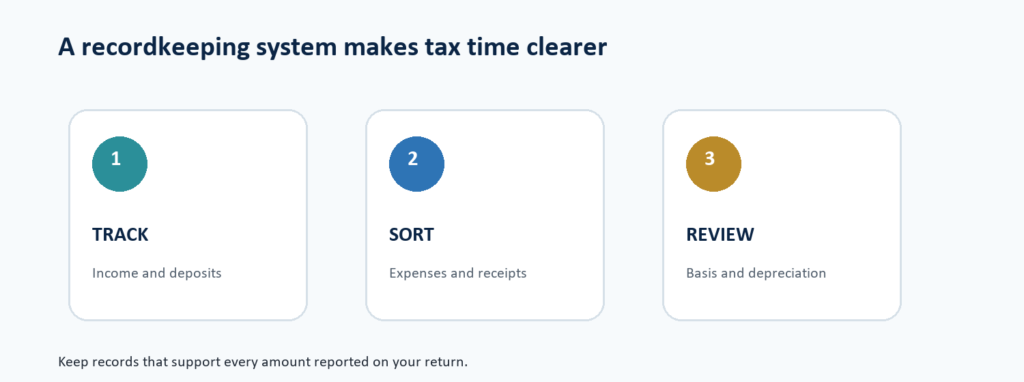
A practical rental-tax recordkeeping checklist
- Track rent received, deposits retained, lease-cancellation payments, and tenant-paid expenses separately.
- Save invoices and proof of payment for repairs, maintenance, advertising, insurance, utilities, taxes, professional fees, and management costs.
- Keep closing documents and a written allocation between land and building; retain records for later improvements.
- Maintain a property-use calendar for vacation homes, shared homes, and rentals to relatives.
- Reconcile the year’s records to Form 1098 mortgage interest information and property-tax records where applicable.
- Review prior-year depreciation schedules and carryforward losses before preparing the return.
Frequently asked questions
Is rent from a residential property taxable?
Generally, yes. The IRS says rental income includes amounts received for the use or occupation of property, subject to special rules for certain personal-use situations.
Can I deduct mortgage interest and property taxes?
They may be deductible rental expenses to the extent they relate to the rental activity and meet the applicable rules. Personal-use portions must be treated separately.
Can I deduct the full cost of a new roof or remodel this year?
Not automatically. A cost that is an improvement may need to be capitalized and depreciated. Evaluate the facts and retain all supporting documents.
Do I report every rental on Schedule E?
Many residential rentals are reported on Schedule E, but significant services, dealer property, farm rentals, and other facts can require different reporting.
Why does depreciation matter if I did not claim it?
Depreciation affects adjusted basis and may affect the tax result when the property is sold. Proper records and professional review are important.
How Liberty Tax Accounting can help
Rental property tax 2026 are manageable when the records are organized before filing season. Liberty Tax Accounting can help you classify income and expenses, review depreciation and basis records, identify reporting issues, and prepare a clear federal and state filing plan. Contact us for a confidential rental-tax review.