
IRS PAYMENT PLANS
A 2026 tax-season guide to payment options, eligibility, applications, and staying on track
Key takeaways
- File your return on time even if you cannot pay the full balance. Filing and paying are separate obligations; filing on time can help avoid the failure-to-file penalty.
- For qualified individuals, the IRS generally offers a short-term plan of 180 days or less for balances under $100,000, and a long-term monthly plan for balances of $50,000 or less, provided required returns have been filed.
- A Simple Payment Plan is a streamlined long-term option for many qualified taxpayers. Interest and applicable penalties continue until the liability is paid in full.
- Use the IRS Online Account or Online Payment Agreement application to review available options, obtain an immediate decision when eligible, and manage an existing agreement.
IRS source: Payment plans; installment agreements
What is an IRS payment plan?
An IRS payment plan is an agreement to pay a federal tax balance over a defined period instead of in one lump sum. It is not a forgiveness program, and it does not stop interest or applicable penalties from accruing on the unpaid balance. It is a structured collection alternative for taxpayers who cannot pay in full now but can make an affordable, consistent payment. For a firm’s clients, that distinction matters: the best plan is usually the one that resolves the debt as quickly as practical without creating a new financial emergency.
A payment plan should be considered after the taxpayer has confirmed the balance and made the largest practical initial payment. The IRS emphasizes paying as much as possible by the original due date; every dollar paid earlier can reduce interest and penalties. A taxpayer should also file all required returns. Being current with filing requirements is a core qualification condition for many plans, and an unfiled return can prevent a streamlined solution from moving forward.
IRS source: IRS Topic no. 202, Tax payment options
What is new and important for the 2026 tax season?
For the 2026 tax season, the IRS describes Simple Payment Plans as long-term plans for qualified individuals and businesses that generally do not require a collection information statement, lien determination, or trust fund recovery penalty determination. The updated program expands streamlined access for qualifying business taxpayers. Eligibility still depends on the taxpayer’s facts, filing and payment compliance, and the balance owed, so clients should treat published thresholds as a starting point rather than a guarantee of approval.
For individuals, the IRS states that a Simple Payment Plan generally applies when assessed tax, penalties, and interest total $50,000 or less. For businesses, the published limits differ by the presence of trust fund taxes and business structure. A qualified out-of-business sole proprietorship may have a different threshold than an operating business. Businesses should contact the IRS using the number on the notice or 800-829-4933 rather than assume the individual online workflow applies.
IRS source: Simple Payment Plans for individuals and businesses
Short-term versus long-term plans
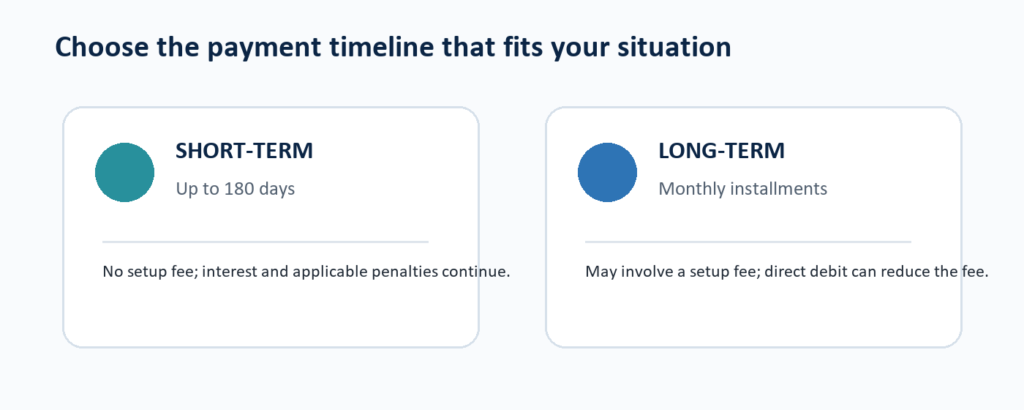
The first choice is often about timing. A short-term payment plan gives eligible taxpayers up to 180 days to pay the balance in full. The IRS says there is no setup fee for this type of plan, but interest and applicable penalties continue until the balance is fully paid. This may be useful when a taxpayer expects a bonus, property sale, receivable, or other reliable cash event soon.
A long-term payment plan, also called an installment agreement, uses monthly payments. Qualified individuals may be able to apply online when their combined tax, penalties, and interest are $50,000 or less and all required returns are filed. The IRS notes that most taxpayers have up to 10 years to pay under a Simple Payment Plan, but a longer period usually means more interest and penalties overall. The application will present the payment options available for the taxpayer’s circumstances.
The practical question is not simply “What is the lowest monthly payment?” A lower payment may preserve cash flow, but it may also extend the payoff period and increase total cost. A useful planning approach is to choose a required payment that is sustainable, then make additional payments whenever cash flow allows. The taxpayer should retain proof of payments and periodically check the online account to ensure the balance and agreement remain in good standing.
IRS source: Online payment agreement application
Eligibility at a glance
| Payment Option | General 2026 Individual Threshold | Key Point |
|---|---|---|
| Short-Term Payment Plan | Less than $100,000 in combined tax, penalties, and interest | Allows taxpayers to pay the balance in 180 days or less. There is generally no setup fee. |
| Simple Payment Plan (Long-Term Installment Agreement) | $50,000 or less in combined tax, penalties, and interest | Monthly installment payments are available. All required tax returns must be filed before approval. |
| Guaranteed Installment Agreement | $10,000 or less in tax (excluding interest and penalties) | Taxpayers must meet additional IRS requirements, including a satisfactory five-year filing and payment history. |
| Partial Payment Installment Agreement (PPIA) | Case-specific (determined by the IRS) | May require submitting a Collection Information Statement and undergoing periodic financial reviews. |
Thresholds summarize IRS guidance and do not replace the IRS eligibility determination. Open bankruptcy proceedings generally affect eligibility, and the IRS may require financial information in more complex situations.
IRS source: Topic no. 202, including Guaranteed and Partial Payment Installment Agreements
How to apply and what to prepare
For eligible individuals, the IRS Online Payment Agreement application is usually the most efficient starting point. It can provide an immediate approval notification after the application is completed. A taxpayer may also request a monthly plan using Form 9465, Installment Agreement Request, through tax software, by mail, or by phone. The IRS may direct a taxpayer to provide a Collection Information Statement, such as Form 433-F, when the proposed payment does not meet the applicable requirements or the situation needs deeper financial review.
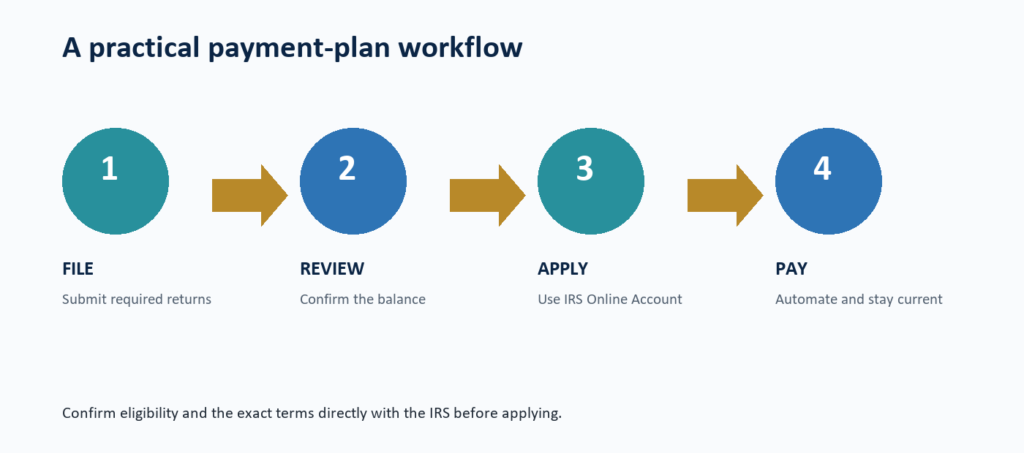
- File every required return. If a current return is not filed, address that first.
- Review the IRS notice and online account. Confirm tax years, balance, and whether a prior agreement exists.
- Decide what can be paid now and what monthly amount is genuinely sustainable. The IRS will ask for a proposed amount and a payment date from the 1st through the 28th.
- Choose a payment method. Direct debit can reduce the setup fee and makes on-time payments easier.
- Save the confirmation, calendar the due date, and keep future filing and payment obligations current.
IRS source: About Form 9465, Installment Agreement Request
Fees, interest, and penalties: the cost of waiting
A payment plan can improve control, but it is not cost-free. The IRS states that a long-term plan may have a user fee, while direct debit typically carries a lower setup fee than non-direct-debit arrangements. The IRS’s current public guidance notes a $22 setup fee for an online direct-debit long-term agreement and says the fee is waived for qualified lower-income taxpayers. Fees can change, and options vary by application method, so taxpayers should review the live IRS application and current payment-plan page before submitting.
Interest and applicable penalties continue to accrue until the balance is paid in full. For a timely filed return with an installment agreement in effect, the IRS explains that the monthly failure-to-pay penalty is generally reduced from one-half of one percent to one-quarter of one percent for each month the agreement is in effect. That reduction does not eliminate interest or make delaying payment inexpensive. When possible, paying extra toward the balance is a direct way to lower the total cost.
IRS source: If you’ve filed but haven’t paid
IRS source: Topic no. 653, IRS notices and bills, penalties and interest charges
Direct debit, Direct Pay, and other payment methods
Direct debit means automatic monthly withdrawals from a checking account under the agreement. It can reduce the setup fee and lower the risk of forgetting a due date. It also requires accurate routing and account information plus authorization for the withdrawals. Taxpayers should make sure the account has sufficient funds before the scheduled date and update the IRS promptly if banking information changes.
Direct Pay is different: it is a one-time payment method from a bank account. It can be used to make a scheduled payment, but it is not the same as an automatic direct-debit agreement. The IRS also lists debit card, credit card, digital wallet, cash through approved third-party processors, checks, money orders, and EFTPS among payment choices. Third-party processors may charge their own fees. A client should select the method that best supports on-time payment and document retention, not simply the most familiar option.
IRS source: IRS payment plans; installment agreements
What happens if a payment is missed?
A missed payment, unfiled future return, or new unpaid tax balance can put an installment agreement into default. The IRS advises taxpayers to pay at least the minimum by the due date, file all required returns on time, and pay current taxes in full. Future refunds are generally applied to the tax debt while it remains unpaid, but scheduled agreement payments should still be made. If a plan defaults, a reinstatement fee may apply.
Do not wait for the problem to compound. Individuals may be able to use the online account to change a monthly payment amount or due date, convert to direct debit, update bank information, or reinstate after default. If an urgent balance-due or termination notice arrives, follow the notice instructions and contact the IRS promptly. The IRS generally will not take enforced collection action while a plan is being considered, while it is in effect, for 30 days after a rejection or termination, or during review of a timely appeal of a rejected or terminated agreement.
IRS source: Managing a payment plan and avoiding default
When another option may fit better
An installment agreement is not the only possible response to a balance due. If paying in full or through installments is not realistic, the IRS describes other paths, including an Offer in Compromise and a temporary delay in collection when the taxpayer’s financial situation improves. Those options have separate eligibility standards and documentation requirements. They should not be presented as automatic alternatives or as a reason to ignore a current IRS notice. The right path depends on the verified liability, household or business cash flow, assets, compliance history, and collection timeline.
IRS source: Publication 594, The IRS Collection Process
A smart pre-application checklist
Before starting the application, clients should treat the process as a short financial review rather than a formality. First, separate the federal balance from any state or local obligations; an IRS plan does not resolve taxes owed to another authority. Next, review the last several months of actual cash flow. A payment amount built on a hopeful estimate rather than recurring income and essential expenses is more likely to fail. Where cash flow varies, choose a minimum that is conservative enough to make every month, then use stronger months to make extra payments.
It is also helpful to identify what caused the balance. A one-time capital gain, retirement distribution, self-employment income, withholding shortfall, or estimated-tax gap may call for a different forward-looking fix. For example, a taxpayer with recurring self-employment income may need to adjust estimated tax payments while paying the old balance. Without that adjustment, the taxpayer can be compliant with the installment agreement today but create a new balance next filing season. A tax professional can help convert that diagnosis into a practical withholding, estimate, or bookkeeping plan.
Clients should keep the confirmation letter, notice copies, proof of every payment, and a current contact address. If the IRS sends a notice, compare it with the online account and act promptly. This recordkeeping is especially valuable when a payment is delayed by a bank issue, a refund offset occurs, or a client needs to explain a change in circumstances. Clear records do not replace IRS rules, but they make it easier to address a question before it becomes a default.
Common mistakes to avoid
- Waiting to file because full payment is not available. File on time whenever possible, then address payment options.
- Choosing an unrealistically low payment without understanding the payoff period and total cost.
- Treating a tax refund as a replacement for the monthly installment. Refund offsets generally do not remove the obligation to make scheduled payments.
- Ignoring new tax obligations while a plan is active. Staying current is essential to preventing default.
- Assuming business and individual rules are identical. Business cases, especially those involving trust fund taxes, require careful IRS-specific review.
- Relying on outdated fee schedules or unofficial summaries instead of checking the live IRS payment-plan information.
Frequently asked questions
Can I get an IRS payment plan if I have not received a bill yet?
The IRS states that a taxpayer may establish a pre-assessed agreement by entering the balance expected from the tax return. Eligibility and options depend on the taxpayer’s situation; the Online Payment Agreement application is the best official starting point.
Can I change my existing IRS payment plan?
Often, yes. The IRS says eligible taxpayers can use their Online Account to change the payment amount or due date, convert to direct debit, change bank information, or request reinstatement after default. If online changes are unavailable, call the IRS or follow the notice instructions.
Will an IRS payment plan stop interest and penalties?
No. Interest and applicable penalties generally continue until the balance is fully paid. A timely filed return with an installment agreement in effect may receive a reduced monthly failure-to-pay penalty, subject to IRS rules.
Can a business apply online?
The IRS’s Online Payment Agreement page says business accounts cannot apply online for a payment plan. Businesses should call the number on the notice or 800-829-4933. Sole proprietors and independent contractors generally apply as individuals.
How long can I take to pay?
The IRS says most taxpayers may have up to 10 years to pay under a Simple Payment Plan, subject to the collection statute and the taxpayer’s situation. A shorter plan generally reduces added interest and penalties.
What if I cannot afford the monthly amount required?
The IRS may require a Collection Information Statement and supporting financial information. A partial-payment agreement or another collection alternative may be considered based on the facts. Do not submit incomplete or inaccurate financial information.
How Liberty Tax Accounting can help
A tax balance deserves a plan, not panic. Liberty Tax Accounting can help you review IRS notices, verify filing compliance, estimate a sustainable payment approach, prepare the appropriate documentation, and keep future tax obligations on track. Contact our team for a confidential discussion before a missed payment or unanswered notice creates a bigger problem.