
Tax Penalties Explained: The Most Common IRS Penalties for the 2026 Season
The IRS assesses more than 150 different civil tax penalties under the Internal Revenue Code, but the overwhelming majority of taxpayers only ever encounter a handful of them. Understanding how these penalties are calculated — and which ones stack on top of each other — can be the difference between a manageable notice and a balance that spirals.
This guide breaks down tax penalties for the 2026 season using the IRS’s own published guidance: the six most common penalty types, how failure-to-file and failure-to-pay interact, the accuracy-related penalty, payroll deposit penalties, and the relief options available to reduce or eliminate what you owe.
The Six Most Common IRS Penalties
Per the IRS Penalties overview page, the IRS charges a penalty for several distinct reasons — not filing on time, not paying on time, filing an inaccurate return, not depositing employment taxes correctly, and more. Here’s how the most common ones compare at a glance:
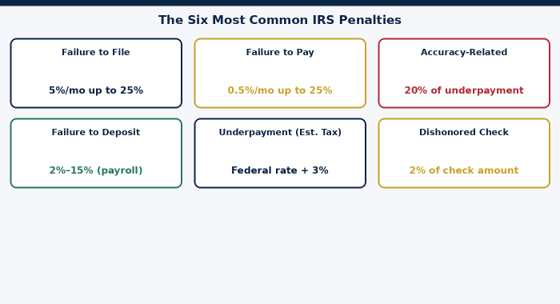
Each of these operates independently, with its own calculation method, and several can apply to the same taxpayer at once. Interest, which is separate from all of these penalties, compounds daily on any unpaid balance at the federal short-term rate plus 3 percentage points — and unlike penalties, interest has no cap.
Failure to File vs. Failure to Pay: The Most Common Pair
Per IRS Topic No. 653, the two most frequently assessed penalties are also the most misunderstood. Filing late and paying late sound similar, but the cost difference is dramatic.
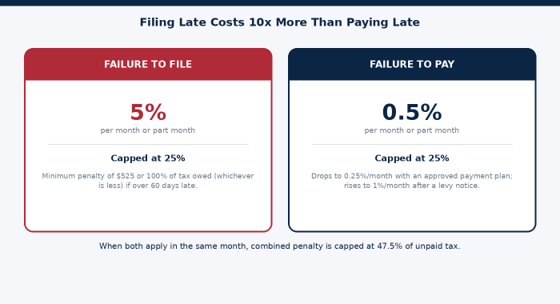
The failure-to-file penalty is 5% of unpaid tax per month, capped at 25%, with a minimum penalty — for returns due in 2026 — of $525 or 100% of the tax owed, whichever is less, once a return is more than 60 days late. The failure-to-pay penalty is far gentler at 0.5% per month, also capped at 25%, and drops to 0.25% per month under an approved installment agreement. Per the IRS Failure to Pay Penalty page, when both penalties apply in the same month, the failure-to-file rate is reduced by the failure-to-pay amount, so the combined rate never exceeds 5% per month or 47.5% total. The lesson stays the same every year: always file on time, even if you can’t pay in full.
The Accuracy-Related Penalty: 20% of What You Got Wrong
Unlike the penalties above, the accuracy-related penalty applies even when a return is filed and paid on time — it targets returns that are simply incorrect. Per the IRS Accuracy-Related Penalty page, this penalty equals 20% of the portion of an underpayment attributable to negligence or a substantial understatement of tax.
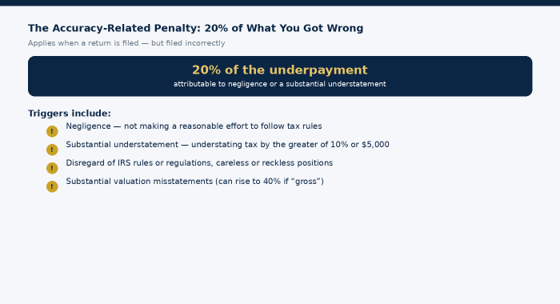
A “substantial understatement” for individuals means understating tax by the greater of 10% of the tax required to be shown on the return or $5,000. Common triggers include leaving income off a return that was reported to the IRS on a Form 1099, or claiming a deduction or credit without a reasonable basis. In cases involving gross valuation misstatements, the rate can climb to 40%.
Failure-to-Deposit Penalty: Payroll Taxes Play by Different Rules
Employers face a separate, tiered penalty structure for late or short federal tax deposits. Per IRS Publication 15 (Circular E), the failure-to-deposit penalty increases the longer a deposit remains outstanding:
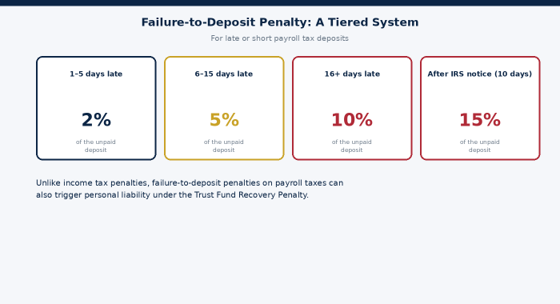
Because withheld payroll taxes are trust fund money, mishandling them carries a risk beyond this tiered penalty: the Trust Fund Recovery Penalty can hold a responsible individual personally liable for 100% of unpaid withheld taxes, separate from the business’s own liability.
Other Penalties Worth Knowing About
Underpayment of Estimated Tax
Per IRS Topic No. 306, this penalty applies when withholding and estimated payments together fall short of the required amount during the year, and is calculated separately for each quarterly period at the federal short-term rate plus 3%.
Dishonored Check or Payment
Per the IRS Dishonored Check Penalty page, a bounced check or rejected electronic payment triggers a penalty of 2% of the payment amount, or the lesser of $25 or the payment amount for payments under $1,250.
Information Return Penalties
Businesses that fail to file or furnish required information returns — such as Forms 1099 or W-2 — on time and correctly can face a separate, per-form penalty under the Information Return Penalties page, which increases the later a corrected form is filed.
How to Reduce or Remove a Penalty
Penalties aren’t necessarily permanent. The IRS offers several paths to relief, and the earlier you pursue them, the more options remain available.
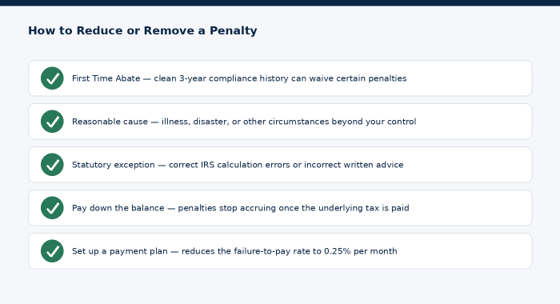
Per the IRS Penalty Relief page, taxpayers with a clean three-year compliance history may qualify for First Time Abate, which can waive certain penalties administratively without needing to prove hardship. Taxpayers who don’t qualify may still establish reasonable cause — circumstances like serious illness, natural disaster, or reliance on incorrect professional advice — to request abatement. And simply paying down the underlying balance or entering an installment agreement slows or stops penalties from continuing to accrue.
How can Liberty Tax Accounting help you
Liberty Tax Accounting helps individuals and businesses respond to IRS penalty notices, pursue First Time Abate and reasonable cause relief, and get back into compliance. Contact us today for a confidential review of your tax penalty notice.