
Home Office Deduction: Essential 2026 Tax Guide
What self-employed professionals should know about qualifying, calculating and documenting a business use of home deduction.
Home Office Deduction: what it means for the 2026 tax season
Home Office Deduction rules matter during the 2026 tax season because taxpayers are preparing federal returns for the 2025 tax year. The IRS began accepting 2025 individual returns on January 26, 2026, and most calendar-year filers had until April 15, 2026, to file and pay any tax due. For eligible business owners, a qualified business use of the home can be one important part of an accurate return.
The IRS describes the core rules in Publication 587, Business Use of Your Home, which is the primary federal reference for 2025 returns.
Who can claim a Home Office Deduction?
The Home Office Deduction is generally for taxpayers who use part of their home in connection with a trade or business. A sole proprietor, independent contractor or other self-employed taxpayer may qualify when the space and the business use meet the IRS tests. Working at home as an employee does not, by itself, create a federal home office deduction for a 2025 return.
The IRS notes that the simplified method does not change who qualifies and that employee business expenses are no longer claimed as miscellaneous itemized deductions under the general federal rule. IRS: Simplified option for home office deduction provides the current framework.
Your home can include a house, apartment, condominium, mobile home, boat or similar property that provides living accommodations. The space does not need to be a separate building, but it must be used in a way that satisfies the business-use rules.
The three tests to understand
1. Regular use
The business use must be regular. Occasional work at the kitchen table, a few calls from the sofa or using a spare room once in a while is not the same as maintaining a recurring business workspace. The IRS looks at the facts and circumstances, so keep records that demonstrate ongoing use.
2. Exclusive use
The area generally must be used only for business. A desk located in a room that is also used for personal activities can create a problem. A dedicated room, a clearly defined portion of a room or a separate structure can work when it is used exclusively and regularly for the business. Publication 587 includes special rules for daycare facilities and certain inventory-storage situations.
3. A qualifying business connection
The home office can qualify if it is your principal place of business, a place where you regularly meet patients, clients or customers, or a separate structure used in connection with the business. A home office used exclusively and regularly for administrative or management activities can qualify as a principal place of business if there is no other fixed location where you conduct substantial administrative or management activities.
Home Office Deduction: simplified method or actual expenses?
Once the workspace qualifies, there are two common approaches to calculating the deduction. The right method is not always the one that produces the largest-looking number; it is the method that fits the taxpayer’s records, facts and filing position.
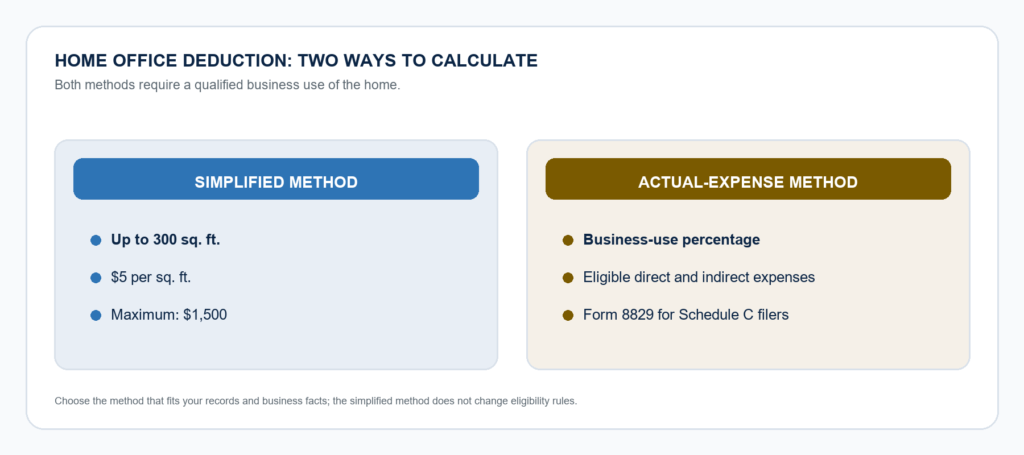
| Method | How It Works | Key Recordkeeping Point |
|---|---|---|
| Simplified Method | Uses $5 per square foot of qualifying business space, up to a maximum of 300 square feet. The maximum deduction is $1,500. | Document the qualifying business space and its square footage. This method does not allow a depreciation deduction for the home-office portion of the property. |
| Actual Expense Method | Calculates the deduction using the business-use percentage of eligible direct and indirect home expenses. Sole proprietors filing Schedule C generally use Form 8829. | Maintain detailed records for eligible expenses such as rent, mortgage interest (if applicable), property taxes, insurance, utilities, maintenance, repairs, and depreciation where allowed. |
Keep the records that support your deduction
Good records make this deduction easier to substantiate and easier to calculate. The exact documents depend on the method you use, but the key is to show the business use of the space and the basis for the amount claimed.
- A simple floor plan, measurements or other record showing the business area and the total home area.
- Evidence of regular business use, such as appointment records, client files, invoices, bookkeeping work or business calendars.
- For the actual-expense method, receipts and statements for rent, utilities, insurance, repairs, maintenance, mortgage interest, property taxes and other potentially relevant costs.
- The date business use began, especially if the space was used for only part of the year.
- A record of direct expenses for the office area versus indirect expenses that benefit the whole home.
Publication 587 explains the distinction between direct, indirect and unrelated expenses and the potential limit on business-use-of-home deductions. Review the IRS guidance before treating a household cost as a business expense.
How to claim the deduction accurately
For a qualifying self-employed taxpayer who files Schedule C, the simplified method is generally reported directly on Schedule C, while the actual-expense method is generally calculated using Form 8829. The actual-expense method requires allocating home costs between personal and business use. Direct expenses for the business area may be treated differently from indirect expenses that benefit the whole home.
This deduction is also subject to a business-income limit. In broad terms, certain home-office expenses cannot create or increase a business loss. The regular and simplified methods handle amounts above the limit differently, which is one reason a method comparison should be part of the tax-preparation conversation.
For a concise IRS overview of filing and method choices, see How small business owners can deduct their home office from their taxes.
Avoid common home-office mistakes
- Claiming a room or desk that is also used for personal purposes without considering the exclusive-use rule.
- Using an estimate for square footage or expenses without retaining a reasonable basis and supporting records.
- Deducting the full amount of a whole-home expense instead of the business share when using actual expenses.
- Assuming every remote employee can claim the deduction on a federal return.
- Forgetting that a home office started midyear generally requires a part-year calculation.
- Ignoring the effect of depreciation and future sale-of-home considerations under the actual-expense method.
Home Office Deduction help from Liberty Tax Accounting
If you need help with the Home Office Deduction, contact Liberty Tax Accounting. Our team can help you assess whether your business use of home appears to qualify, organize the records needed for a calculation, compare the simplified and actual-expense methods, and prepare an accurate filing strategy. Reach out for support with this deduction or any other tax question affecting your business.