Head of Household Filing Status: The 2026 Guide to Who Qualifies and What It Saves
If you’re unmarried and supporting a household on your own, Head of Household (HOH) is one of the most valuable filing statuses in the tax code — and also one of the most frequently misclaimed. Choosing it when you don’t actually qualify can trigger an IRS notice and a bill for back taxes; not claiming it when you do qualify means leaving real money on the table.
This guide breaks down Head of Household filing status for the 2026 tax season using the IRS’s own published guidance in Publication 501: the three-part eligibility test, how much it’s worth compared to filing Single, who counts as a qualifying person, and the documentation that protects your claim.
The Three-Part Test the IRS Actually Applies
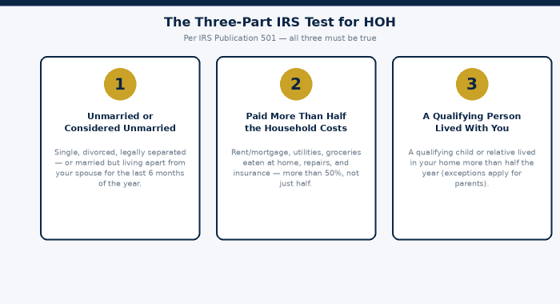
Per IRS Publication 501, qualifying for Head of Household requires all three of the following to be true — not just one or two:
All three conditions must be met — there's no partial credit.
The first test trips up more people than any other. You don’t have to be divorced to qualify — per Publication 501, you can be “considered unmarried” even while still legally married, if your spouse didn’t live in your home at any time during the last six months of the year, you file a separate return, and you otherwise meet the HOH tests. This is a common situation for separated couples who haven’t yet finalized a divorce.
What Head of Household Is Actually Worth in 2026
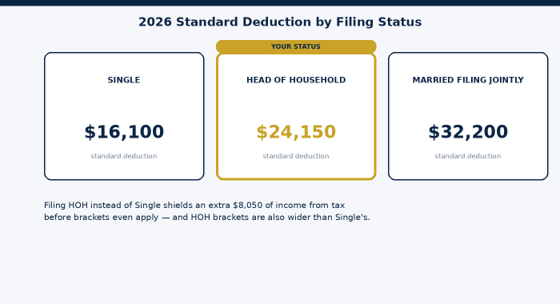
The financial upside of HOH comes from two places: a larger standard deduction and wider tax brackets than Single status. Per Revenue Procedure 2025-32, the 2026 standard deduction for Head of Household is $24,150 — noticeably higher than the $16,100 available to Single filers.
HOH sits between Single and Married Filing Jointly — closer to the married benefit.
Beyond the larger deduction, HOH tax brackets are also wider than Single brackets at every income level, meaning more of your income is taxed at lower marginal rates before you cross into the next bracket. Together, these two effects can meaningfully lower a qualifying taxpayer’s total tax bill compared to filing Single with the exact same income.
Who Counts as a Qualifying Person?
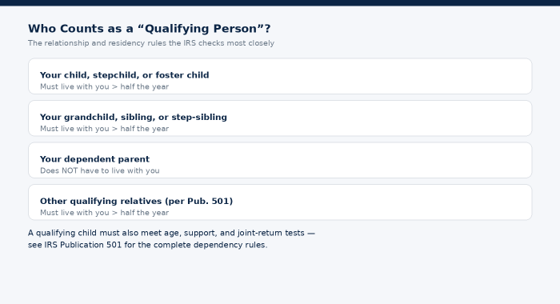
The third test — having a qualifying person live with you — is where the IRS’s rules get the most specific. Per IRS Publication 501, a qualifying person is generally a qualifying child or a qualifying relative, subject to relationship and residency requirements:
Most qualifying persons must live with you — a dependent parent is the notable exception.
The dependent parent exception is one of the more overlooked HOH rules: if you pay more than half the cost of maintaining your parent’s own home (or a nursing home) and they qualify as your dependent, you may claim HOH even though they never live with you. Every other qualifying person generally must live in your home for more than half the year, with limited exceptions for temporary absences like school, illness, or military service.
Common Mistakes That Trigger IRS Notices
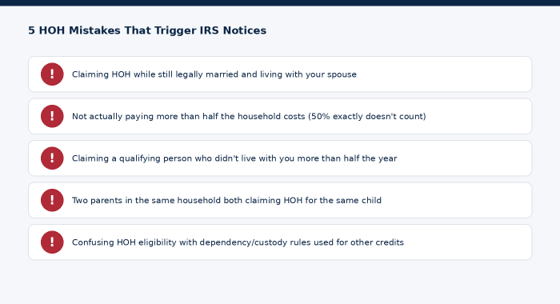
Most HOH problems trace back to one of these five issues.
Two parents claiming the same child
Only one taxpayer can claim a given child as their qualifying person for HOH purposes in a given year, even in shared-custody situations. The IRS’s tiebreaker rules generally favor the parent the child lived with for the greater number of nights.
The “exactly half” trap
Paying precisely 50% of household costs does not satisfy the test — the IRS requires more than half. Keeping a simple running total of household expenses during the year avoids a close call at filing time.
Mixing up HOH rules with dependency rules
Qualifying for the Child Tax Credit or claiming someone as a dependent doesn’t automatically mean you qualify for HOH, and vice versa — the tests overlap but aren’t identical, particularly in divorced or separated households where a noncustodial parent may claim a dependency exemption without qualifying for HOH.
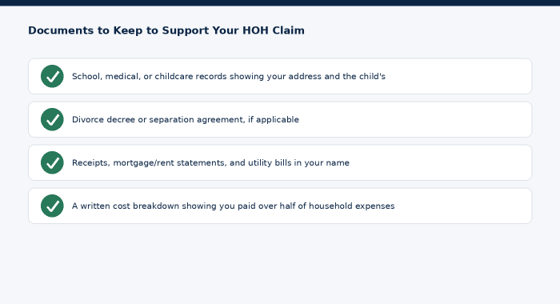
Documentation That Protects Your HOH Claim
Because HOH is one of the most frequently scrutinized filing statuses, keeping supporting records makes responding to any IRS inquiry straightforward.
A little recordkeeping now prevents a scramble if the IRS asks later.
The IRS has specifically used Form 886-H-HOH in the past to request this type of documentation directly from taxpayers claiming HOH, underscoring how closely this status is reviewed. Keeping the records outlined above on hand each year is the simplest way to be ready if a notice arrives.
How can Liberty Tax Accounting help you
Liberty Tax Accounting helps individuals confirm the correct filing status, maximize eligible deductions, and keep documentation ready in case of an IRS inquiry. Contact us today for a confidential review of your filing status.