
Failure to Pay Penalty: What It Costs You in the 2026 Tax Season (And How to Avoid It)
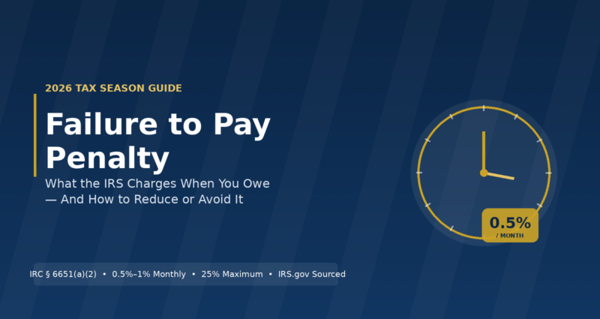
If you filed your return but couldn’t pay the full balance, the IRS charges a Failure to Pay Penalty — a monthly charge on your unpaid tax that keeps growing until the balance is settled. With the 2026 filing deadline behind many taxpayers and extension deadlines approaching, understanding exactly how this penalty is calculated, how it differs from the Failure to File Penalty, and how to get relief can save you hundreds or thousands of dollars.
This guide breaks down the Failure to Pay Penalty using the IRS’s own published rules for the 2026 tax season, including current interest rates, penalty caps, and the newly announced automatic relief program replacing First Time Abate.
What Is the Failure to Pay Penalty?
The Failure to Pay Penalty applies when you don’t pay the tax you owe by the original due date of your return — even if you filed on time or received a filing extension. According to the IRS Failure to Pay Penalty page, the penalty is a percentage of the unpaid taxes shown on your return, and it continues to accrue for every month or partial month the balance remains outstanding.
Unpaid tax is defined as the total tax required to be shown on your return, minus any amounts already paid through withholding, estimated payments, or refundable credits. Importantly, an extension to file is not an extension to pay — the penalty clock starts on the original April deadline regardless of any filing extension you were granted.
How the IRS Calculates the Failure to Pay Penalty in 2026
Per IRS Topic No. 653, the standard failure-to-pay rate is:
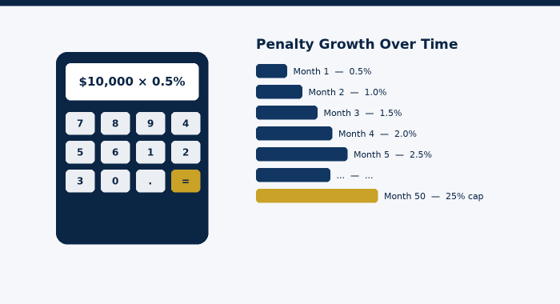
- 5% of the unpaid tax for each month or part of a month the balance remains unpaid
- Capped at a maximum of 25% of the unpaid tax
- Increases to 1% per month if the IRS issues a notice of intent to levy and you still haven’t paid within 10 days
- Decreases to 0.25% per month while an approved installment agreement is in effect and you filed your return on time
Example: If you owe $10,000 and pay nothing for five months, you accumulate roughly $250 in failure-to-pay penalties before interest is added — and that’s before combining it with any failure-to-file exposure.
Failure to Pay vs. Failure to File: Know the Difference
Many taxpayers confuse the Failure to Pay Penalty with the Failure to File Penalty. They are separate charges under the Internal Revenue Code, and the difference is significant. Per the IRS Failure to File Penalty page and IRS Collection Procedural Questions FAQ:
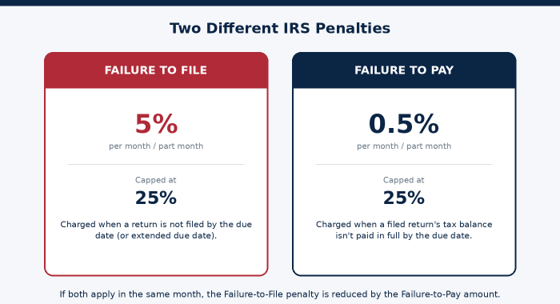
When both penalties apply in the same month, the failure-to-file penalty is reduced by the failure-to-pay amount for that month, and the combined maximum penalty is 47.5% of the unpaid tax (22.5% for late filing plus 25% for late payment).
The takeaway for the 2026 season: always file on time, even if you can’t pay in full. The failure-to-file penalty is ten times more expensive per month, so filing late to “save money” almost always backfires.
Don't Forget Interest — It Stacks on Top of the Penalty
Separate from the penalty itself, the IRS charges daily-compounding interest on any unpaid tax, penalties, and interest from the original due date until the balance is paid in full. Per the IRS Quarterly Interest Rates page, the individual underpayment rate is the federal short-term rate plus three percentage points, reset every quarter.
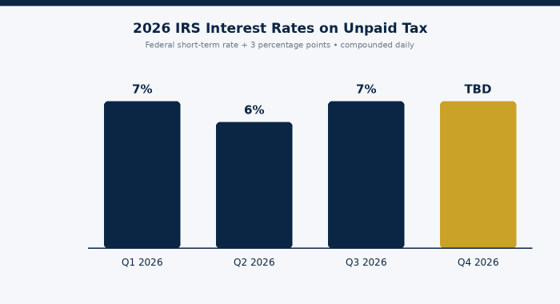
For the 2026 tax season, individual underpayment interest sat at 7% in Q1, dropped to 6% in Q2, and rose back to 7% in Q3 — meaning a balance left unpaid across the year compounds daily at a meaningfully high rate. Unlike penalties, interest generally cannot be waived, even with reasonable cause.
How to Reduce or Avoid the Failure to Pay Penalty
The IRS offers several legitimate paths to reduce or eliminate this penalty. The earlier you act, the more options you have.
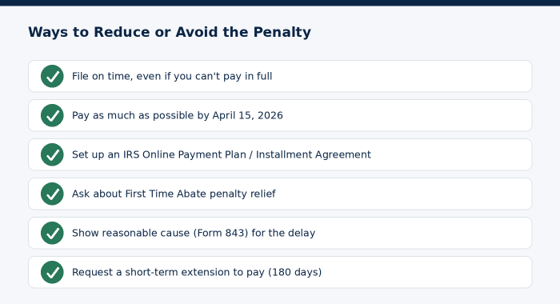
1. File on time, even without full payment
This alone avoids the much larger failure-to-file penalty and immediately caps your exposure to the 0.5% monthly rate.
2. Set up an IRS payment plan
Individuals who owe $50,000 or less in combined tax, penalties, and interest can typically get instant approval through the IRS Online Payment Agreement application. Per IRS Topic No. 202, a short-term plan (up to 180 days) carries no setup fee, and while filing a return on time with an installment agreement in place, the failure-to-pay rate drops to just 0.25% per month. See the full Payment Plans / Installment Agreements page for eligibility and fees.
3. Request penalty relief — the rules changed for 2026
Historically, taxpayers with three years of clean compliance history could request First Time Abate (FTA). According to an IRS newsroom announcement, the IRS began phasing out FTA during summer 2026 in favor of a new Automatic Exemption from Penalty (AEP) program, which will apply automatically to eligible returns with original due dates on or after January 1, 2027. During the transition, eligible taxpayers may still request FTA directly — see the Administrative Penalty Relief page for current status.
4. Claim reasonable cause
If you don’t qualify for automatic relief, you may still qualify for penalty abatement by demonstrating reasonable cause — circumstances beyond your control that prevented timely payment (serious illness, natural disaster, or similar hardship). Details are on the Penalty Relief for Reasonable Cause page. Relief requests are typically submitted using Form 843, Claim for Refund and Request for Abatement.
5. Review your notice for accuracy
Every penalty notice cites the specific Internal Revenue Code section applied and the calculation period. Cross-check the numbers against IRS Topic No. 653 before assuming the amount is correct — the IRS applies payments to tax first, then penalties, then interest, which can affect the running total.
Frequently Asked Questions
Does filing an extension avoid the Failure to Pay Penalty?
No. A filing extension only extends the time to submit your return — it does not extend the time to pay. Interest and the failure-to-pay penalty still begin accruing from the original due date on any unpaid balance.
What's the maximum I could owe in penalties?
The combined failure-to-file and failure-to-pay penalty is capped at 47.5% of your unpaid tax, plus daily-compounding interest, which has no cap.
Can the Failure to Pay Penalty be removed?
Yes, in many cases — through the new Automatic Exemption from Penalty program, a First Time Abate request during the transition period, or a reasonable cause claim. Interest, however, is rarely waived.
What if I genuinely can't pay anything?
File your return regardless, then contact the IRS about payment plan options or, in hardship cases, ask about Currently Not Collectible status. Review the IRS Penalties overview for a full summary of penalty types and your rights and options.

Failure to Pay Penalty help from Liberty Tax Accounting
Liberty Tax Accounting helps individuals and businesses respond to IRS notices, calculate accurate penalty and interest exposure, and pursue every available relief option — including the new Automatic Exemption from Penalty program. Contact us today for a confidential review of your IRS balance.