Estimated Taxes Explained: The 2026 Guide to Deadlines, Safe Harbor, and Avoiding Penalties
If you’re self-employed, run a small business, or earn income without withholding, estimated taxes are one of the easiest things to miscalculate — and one of the most expensive to get wrong. The IRS runs on a pay-as-you-go system, and waiting until April to settle up on income that had no withholding can trigger an underpayment penalty even if you eventually pay in full.
This guide breaks down estimated taxes for the 2026 tax season using the IRS’s own published guidance: who has to pay, the four quarterly deadlines, the safe harbor rules that protect you from penalties, and how the underpayment penalty actually gets calculated.
Who Actually Needs to Pay Estimated Taxes?
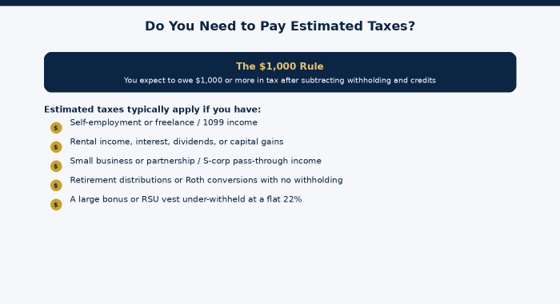
Per the IRS Estimated Taxes FAQ and Form 1040-ES instructions, you generally must make estimated payments if you expect to owe $1,000 or more in tax for 2026 after subtracting withholding and refundable credits, and your withholding won’t cover the smaller of 90% of this year’s tax or 100% (110% for higher earners) of last year’s tax.
The $1,000 threshold and the income types that most often trigger estimated payments.
This most commonly affects self-employed individuals and freelancers, landlords, investors with significant interest, dividend, or capital gains income, partners and S-corp shareholders whose pass-through income isn’t covered by payroll withholding, and retirees taking IRA distributions or doing Roth conversions. Even W-2 employees can get caught off guard — bonuses and RSU vests are typically withheld at a flat 22%, which often runs well below an employee’s actual marginal tax rate.
The Four 2026 Estimated Tax Deadlines
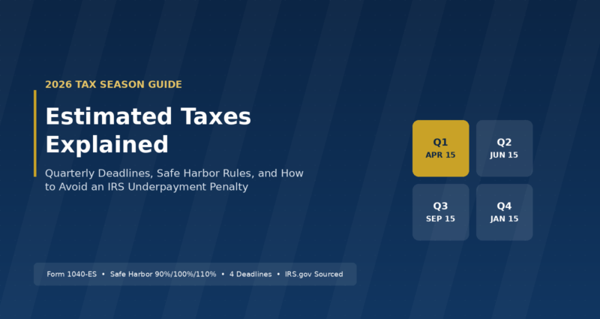
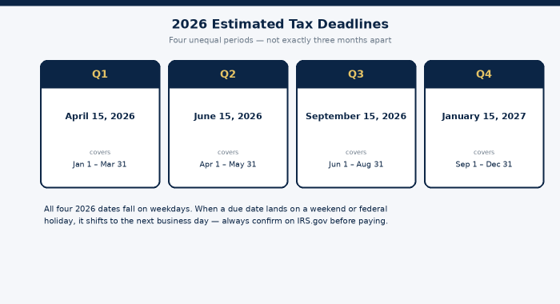
Despite being called “quarterly,” the four estimated tax periods are not evenly spaced. Per the IRS estimated tax due dates page, the 2026 due dates are:
The four unequal 2026 estimated tax periods and their due dates.
Q1: April 15, 2026 — covers January through March
Q2: June 15, 2026 — covers April and May only (a two-month period)
Q3: September 15, 2026 — covers June through August
Q4: January 15, 2027 — covers September through December
You can skip the January 15, 2027 payment if you file your complete 2026 return and pay the full balance due by January 31, 2027. Farmers and fishermen have separate rules under IRS Publication 505 and may only need a single payment.
Safe Harbor: How to Guarantee No Penalty
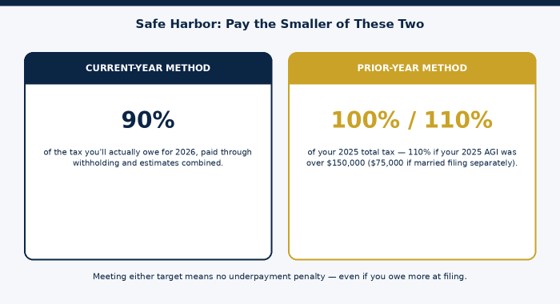
The safest way to handle estimated taxes is to hit an IRS safe harbor — a prepayment target that protects you from an underpayment penalty no matter what you actually owe when you file. Per IRS Topic No. 306, you avoid the penalty by paying the smaller of two amounts:
Pay whichever safe harbor target is smaller to fully protect against a penalty.
The prior-year method is often the simpler choice because the number is already known — your 2025 total tax is fixed, so you can lock in four equal payments early in the year without guessing at 2026 income. If your 2025 adjusted gross income was over $150,000 ($75,000 if married filing separately), the prior-year target rises to 110% instead of 100%.
How to Calculate Your Quarterly Payment
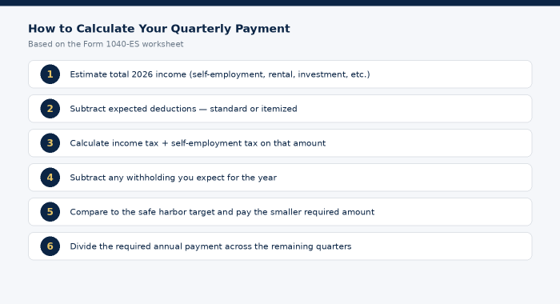
The Form 1040-ES worksheet, condensed into six steps.
The Form 1040-ES worksheet walks through estimating your total income, subtracting deductions, applying current tax brackets and self-employment tax, and comparing the result to your safe harbor target. Whichever number is smaller — the 90% current-year target or the 100%/110% prior-year target — becomes your required annual payment, which you then divide across the quarters that remain.
The Underpayment Penalty Doesn't Work the Way Most People Think
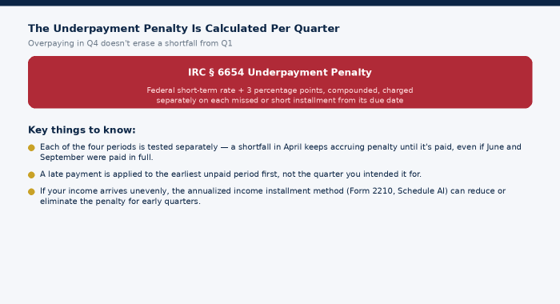
Many taxpayers assume that if they end up square by December, they’re fine. That’s not how it works. Per IRS Topic No. 306, Penalty for Underpayment of Estimated Tax, the penalty under Internal Revenue Code Section 6654 is calculated separately for each of the four periods, based on the federal short-term rate plus 3 percentage points.
A shortfall in one quarter keeps accruing penalty even if later quarters are paid in full.
A shortfall from April keeps accruing penalty interest until it’s actually paid — overpaying in September or January doesn’t retroactively fix a missed spring payment. And a late payment is applied to the earliest unpaid period first, not necessarily the quarter you intended to cover. If your income is lumpy — for example, most of it lands in the fourth quarter — the annualized income installment method on Form 2210, Schedule AI can reduce or eliminate penalties tied to earlier, lower-income quarters.
How to Actually Make the Payment
The IRS offers several ways to submit estimated payments. Per the IRS Make a Payment page, the fastest options are IRS Direct Pay (free, no registration, funds pulled directly from your bank account) and the Electronic Federal Tax Payment System (EFTPS), which requires advance enrollment but allows scheduled recurring payments — useful for locking in all four quarters at once. Paper Form 1040-ES vouchers mailed with a check remain an option but carry more risk of delay or misapplied payments.
How can Liberty Tax Accounting help you
Liberty Tax Accounting helps self-employed individuals, business owners, and investors calculate accurate quarterly payments and avoid underpayment penalties. Contact us today for a confidential review of your 2026 estimated tax plan.