
Cryptocurrency Taxes: 2026 IRS Filing Season Guide

If you bought, sold, swapped, or earned cryptocurrency in 2025, the IRS already has more visibility into your activity than ever before. For the first time, digital asset brokers are issuing Form 1099-DA directly to both you and the IRS — meaning the days of crypto transactions flying under the radar are over.
This guide breaks down Cryptocurrency Taxes for the 2026 filing season using the IRS’s own published guidance: what counts as a taxable event, how capital gains are taxed, how cost basis now has to be tracked wallet-by-wallet, and the most common mistakes that trigger IRS notices.
The IRS Treats Crypto as Property, Not Currency
Every general tax principle that applies to property — stocks, real estate, collectibles — applies to digital assets. Per the IRS Digital Assets page, digital assets include convertible virtual currency, cryptocurrency, stablecoins, and non-fungible tokens (NFTs). Because crypto is property, nearly every disposal — not just cashing out to dollars — can trigger a capital gain or loss.
Every 2025 Form 1040 includes a mandatory digital asset question at the top of the return: “At any time during 2025, did you (a) receive (as a reward, award, or payment for property or services); or (b) sell, exchange, or otherwise dispose of a digital asset (or a financial interest in a digital asset)?” Every taxpayer must check Yes or No — per the Form 1040 instructions, leaving it blank is not an option, even if you never touched crypto that year.
What's New for 2026: Form 1099-DA
Starting with 2025 transactions, covered digital asset brokers — including most centralized exchanges — must report gross proceeds from your sales directly to the IRS using the new Form 1099-DA, Digital Asset Proceeds From Broker Transactions. According to an IRS newsroom reminder, brokers must send you a copy of the same data reported to the IRS by February 17, 2026.
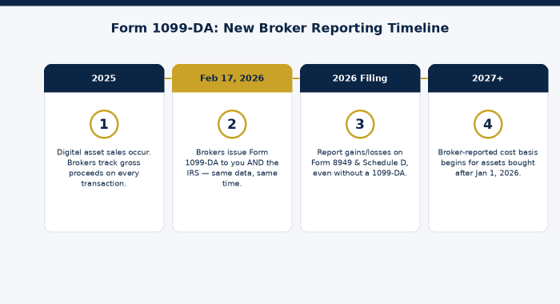
Two important catches for this filing season: most 2025 Forms 1099-DA report gross proceeds only — cost basis reporting by brokers doesn’t become mandatory until 2026 transactions (filed in 2027), and only for assets purchased on or after January 1, 2026. That means you’re still responsible for calculating and substantiating your own cost basis this season. And critically: receiving no Form 1099-DA does not mean nothing is reportable — per the same IRS notice, every taxpayer must report all digital asset income, gains, and losses whether or not a broker sent a form.
What Counts as a Taxable Crypto Event?
Many taxpayers assume only “cashing out” to dollars is taxable. In reality, the IRS treats several everyday crypto activities as reportable dispositions or income.
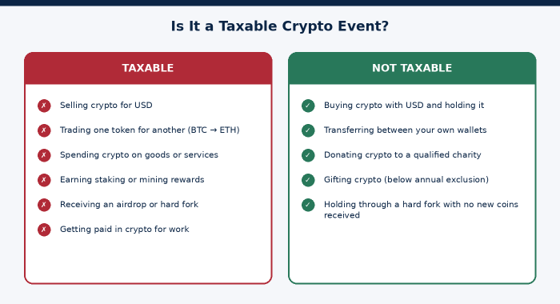
Per the IRS Digital Assets FAQ, simply transferring crypto between wallets or accounts you own and control is not a taxable event — and neither is buying crypto with U.S. dollars and holding it. But trading one token for another, spending crypto, and earning staking, mining, or airdrop rewards are all reportable.
Staking rewards deserve special attention: per Revenue Ruling 2023-14, staking rewards are taxable as ordinary income at their fair market value the moment you gain the ability to sell, exchange, or transfer them — regardless of whether you’ve actually cashed them out.
How Crypto Gains Are Taxed in 2025
Once you’ve established that a transaction is taxable, the next question is how long you held the asset before disposing of it. Holding period determines your tax rate:
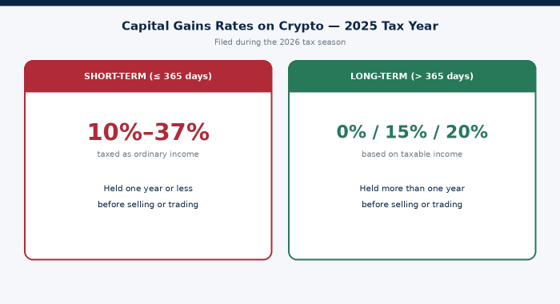
- Short-term (held 365 days or less): taxed as ordinary income at your regular tax bracket — 10% to 37%
- Long-term (held more than 365 days): taxed at preferential capital gains rates — 0%, 15%, or 20%, depending on taxable income
Losses matter too. Capital losses from crypto can offset capital gains and up to $3,000 of ordinary income per year, with any excess carried forward — the same rules that apply to stock losses under IRS Topic No. 409, Capital Gains and Losses.
Cost Basis Rules Changed: Wallet-by-Wallet Tracking Is Now Required
Before 2025, many taxpayers used a “universal” cost-basis method — pooling all holdings across every exchange and wallet, then choosing whichever lot produced the best tax outcome when selling. Final IRS regulations ended that practice.
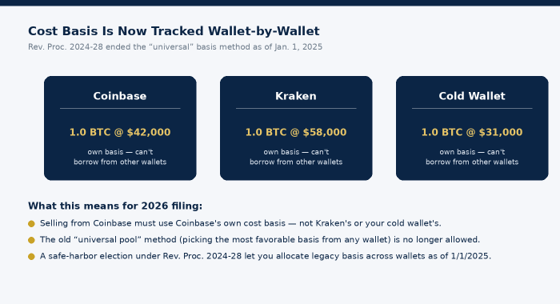
As of January 1, 2025, taxpayers must track cost basis on a wallet-by-wallet or account-by-account basis. Selling crypto from a specific exchange must use that exchange’s own basis — you can no longer borrow a more favorable basis from a different wallet. The IRS provided one-time transition relief in Revenue Procedure 2024-28, allowing taxpayers who used the universal method to reasonably allocate their existing basis across wallets as of January 1, 2025 under a safe harbor. If you can’t substantiate your basis in a given wallet, the IRS can treat the entire sale proceeds as taxable gain — so recordkeeping is now essential, not optional.
Common Crypto Tax Mistakes to Avoid This Season
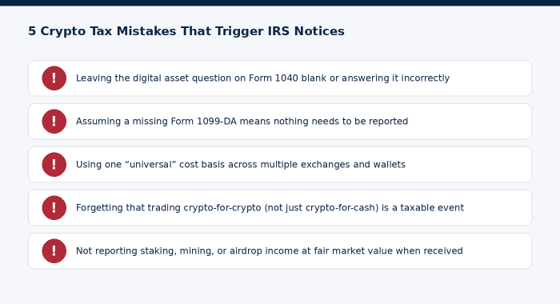
1. Leaving the digital asset question blank
Every filer must check Yes or No. An unanswered question is treated as incomplete and can delay processing or invite scrutiny.
2. Assuming no 1099-DA means nothing to report
DeFi trades, peer-to-peer transactions, and many wallet-to-exchange movements won’t generate a broker form at all — but the underlying gain or loss is still reportable.
3. Mixing up wallets when calculating basis
Since the wallet-by-wallet rule took effect, using a blended or averaged basis across accounts can misstate your gain and doesn’t match how the IRS now expects Form 8949 to reconcile against Form 1099-DA.
4. Forgetting crypto-to-crypto trades are taxable
Swapping Bitcoin for Ethereum is a disposition of the Bitcoin, valued at fair market value on the trade date — even though no dollars ever hit a bank account.
5. Missing staking, mining, or airdrop income
These are ordinary income at the fair market value on the date received, separate from any later capital gain or loss when you eventually sell those coins.
How can Liberty Tax Accounting help you
Liberty Tax Accounting helps individuals, traders, and businesses reconcile wallets, calculate accurate cost basis, and file Form 8949 and Schedule D correctly for crypto activity. Contact us today for a confidential review of your 2025 digital asset transactions.