A clear guide to short- and long-term gains, capital losses, home sales, reporting and planning for the 2026 filing season.
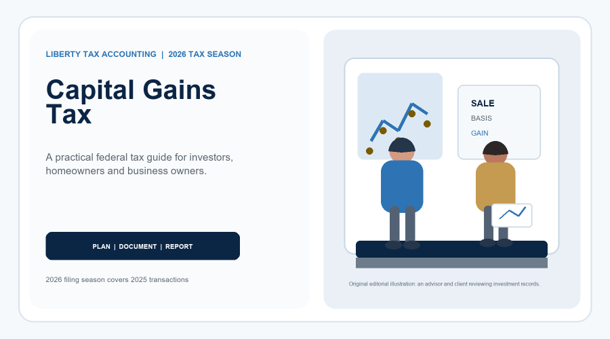
A tax professional and client review investment records before filing
QUICK TAKE: The 2026 filing season covered tax year 2025 transactions. For most calendar-year taxpayers, the original federal filing and payment deadline was April 15, 2026. Capital gains can affect your return even when your sale occurred months before filing.
Capital Gains Tax: what it means for the 2026 tax season
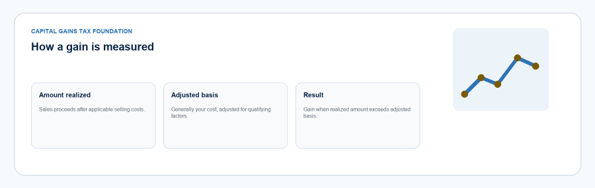
Capital Gains Tax applies when you sell or otherwise dispose of a capital asset for more than its adjusted basis. Capital assets can include investments such as stocks and bonds, a home, and other personal or investment property. The 2026 filing season is the filing season for 2025 federal returns, so 2025 sales need to be reviewed with the records that support your proceeds, basis, dates and adjustments.
The basic relationship between sale proceeds, adjusted basis and gain.
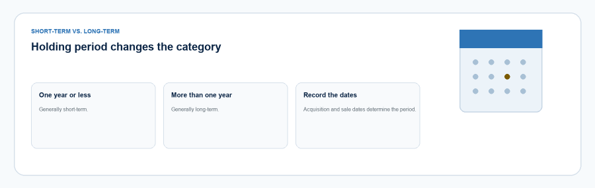
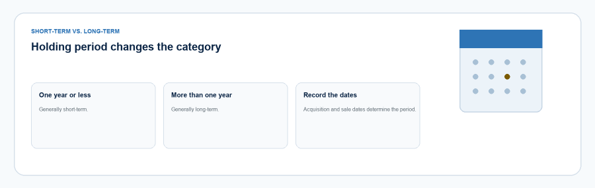
Holding period is a key factor in Capital Gains Tax. Generally, a gain or loss is long-term when you held the asset for more than one year before disposing of it; one year or less is generally short-term. A short-term gain is generally taxed using the ordinary-income rates that apply to your return, while a net long-term gain may qualify for the capital-gain rate structure. Special rules can apply to inherited property, gifts and other transactions, so keep acquisition and sale documentation.
dates are essential to determining whether a transaction is generally short-term or long-term.
Capital Gains Tax rates: why taxable income matters
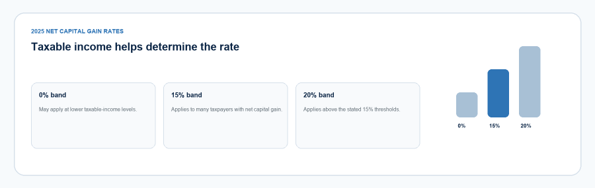
Capital Gains Tax on most net long-term gains is determined with your overall taxable income, not by looking at the sale in isolation. For taxable years beginning in 2025, the IRS lists 0%, 15% and 20% rates for most net capital gain, with rate bands varying by filing status. Certain gains can have different maximum rates, including some collectibles gains, qualified small business stock gains and unrecaptured section 1250 gain. The calculation can become more complex when you have qualified dividends or special categories of gain.
taxable income and filing status can affect the long-term capital-gain rate.
Capital Gains Tax rates: why taxable income matters
Capital Gains Tax on most net long-term gains is determined with your overall taxable income, not by looking at the sale in isolation. For taxable years beginning in 2025, the IRS lists 0%, 15% and 20% rates for most net capital gain, with rate bands varying by filing status. Certain gains can have different maximum rates, including some collectibles gains, qualified small business stock gains and unrecaptured section 1250 gain. The calculation can become more complex when you have qualified dividends or special categories of gain.
taxable income and filing status can affect the long-term capital-gain rate.
2025 FEDERAL LONG-TERM CAPITAL GAIN RATE BANDS FOR MOST NET CAPITAL GAIN
Filing Status
0% Rate When Taxable Income Is
15% Rate When Taxable Income Is
20% Rate Begins Above
Single
$48,350 or less
$48,351 to $533,400
Above $533,400
Married Filing Jointly / Qualifying Surviving Spouse
Capital Gains Tax is based on net results, which is why losses matter. Capital losses can offset capital gains under the IRS netting rules. If total capital losses exceed total capital gains, the IRS generally allows a deduction against other income of up to $3,000, or $1,500 for married taxpayers filing separately, subject to the taxpayer’s net loss. A remaining unused net capital loss may carry forward to later years, and its short-term or long-term character is important.
Capital losses may reduce gains before the annual deduction and carryover rules are considered.
Read the IRS explanation of capital loss deductions and carryovers in Publication 550.
CAUTION: Do not treat a loss as deductible simply because an asset declined in value. Transaction type, holding period, wash-sale rules and whether the property was personal-use can affect the result.
When the 3.8% Net Investment Income Tax may apply
Some taxpayers with significant investment income can owe Net Investment Income Tax in addition to regular Capital Gains Tax. The NIIT is 3.8% of the lesser of net investment income or the excess of modified adjusted gross income over the applicable threshold: $200,000 for single or head-of-household filers, $250,000 for married filing jointly or qualifying surviving spouse filers, and $125,000 for married filing separately. Net gains from property such as stocks, bonds, mutual funds and real estate may be included when the IRS rules apply.
A separate NIIT review may be needed for taxpayers with significant investment income.
Selling a home: an important Capital Gains Tax exception
A sale of your main home deserves a separate Capital Gains Tax review. If you meet the ownership and use tests, you may qualify to exclude up to $250,000 of gain from income, or up to $500,000 on a joint return with your spouse. In general, the rules require ownership and use as a main home for at least 24 months during the five-year period ending on the sale date. Reporting may still be required, including when you receive Form 1099-S or cannot exclude all of the gain.
A home sale can involve an exclusion, but ownership, use and reporting requirements matter.
How to report Capital Gains Tax on your federal return
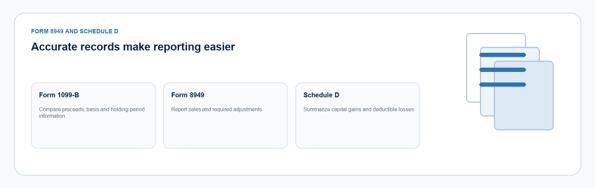
For most sales and other capital transactions, the IRS directs taxpayers to calculate gain or loss on Form 8949 and summarize capital gains and deductible capital losses on Schedule D (Form 1040). Your broker’s Form 1099-B, a Form 1099-DA, Form 1099-S or other records may report proceeds, basis and holding-period information. Reconcile those information forms carefully. The amount reported by a broker may not include every adjustment that affects the correct federal tax result.
Reconcile information forms and supporting records before preparing Form 8949 and Schedule D.
Before filing, gather brokerage statements, Forms 1099-B, 1099-DA or 1099-S, closing documents for real estate, purchase records and records of adjustments to basis. Separate short-term and long-term transactions, review capital loss carryovers from prior returns and identify gains that may have special treatment. If a substantial gain changes your expected tax bill, review whether estimated-tax payments apply. A filing extension gives more time to file, not more time to pay estimated tax due.
A three-step pre-filing check for records, reconciliation and payment planning.
Match each sale to supporting acquisition, basis and sale-date records.
Review Form 1099-B, Form 1099-DA and Form 1099-S entries for accuracy and completeness.
Confirm whether prior-year capital loss carryovers apply to the current return.
Flag main-home sales, investment real estate, digital assets, collectibles and business interests for additional review.
Estimate the effect on your federal tax bill and discuss payment timing if the gain is material.
For the 2026 filing-season deadline and extension rules, see the IRS page When to file.
Capital Gains Tax help from Liberty Tax Accounting
If you need Capital Gains Tax help, Get Capital Gains Tax Help From Liberty Tax Accounting. Our team can help you organize sale and basis records, review information forms, evaluate capital-loss carryovers, coordinate gain reporting with the rest of your return and prepare a complete federal filing. Whether your question involves investments, a home sale, digital assets or another capital transaction, reach out to Liberty Tax Accounting for practical support tailored to your situation.
Liberty Tax Accounting provides practical support for capital-gain reporting questions.