Form 1099-K Explained: The 2026 Tax Season Guide for Payment App Users
If you sell on Etsy, drive for a rideshare app, freelance on the side, or just use Venmo or PayPal to collect payments, you’ve probably heard conflicting things about Form 1099-K. The reporting threshold has changed four times in five years, leaving many taxpayers unsure of what actually applies. As of 2025, the rules are settled — and this guide breaks down exactly what changed.
This article covers Form 1099-K for the 2026 filing season using the IRS’s own updated guidance: the current threshold, what counts as reportable income, common situations that confuse taxpayers, and exactly what to do if one lands in your mailbox.
What Is Form 1099-K?
Per the IRS General FAQs on Form 1099-K, Form 1099-K, Payment Card and Third Party Network Transactions, is an information return used by payment settlement entities — payment card processors and third-party payment platforms — to report payments received for goods or services. It shows the gross amount of reportable transactions, before any fees, refunds, or adjustments are subtracted.
Platforms like PayPal, Venmo, Cash App for Business, Stripe, Square, Etsy, eBay, Airbnb, and Uber all qualify as issuers under this rule when a user crosses the applicable threshold in a calendar year.
The Threshold Rollercoaster — and Where It Landed for 2026
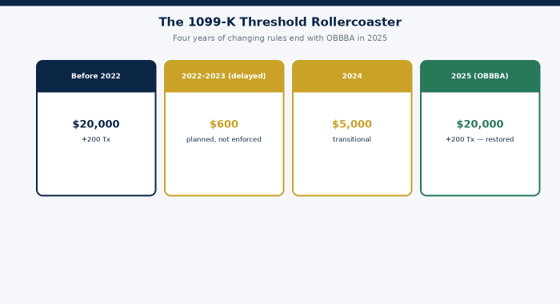
Few tax forms have had a messier recent history. Per IRS Fact Sheet 2025-08, the One, Big, Beautiful Bill Act (OBBBA), signed into law in July 2025, retroactively reinstated the reporting threshold that existed before the American Rescue Plan Act of 2021.
Four different thresholds in four years — OBBBA settled it at the original level.
For 2025 activity (the returns filed during the 2026 season) and all years going forward, a third-party settlement organization is not required to issue Form 1099-K unless a payee’s gross reportable payments exceed $20,000and the number of transactions exceeds 200 — both conditions must be met. One important exception: payment card transactions (credit, debit, or gift cards) have no minimum threshold at all — a business accepting card payments can receive a 1099-K regardless of volume.
Goods and Services vs. Personal Payments
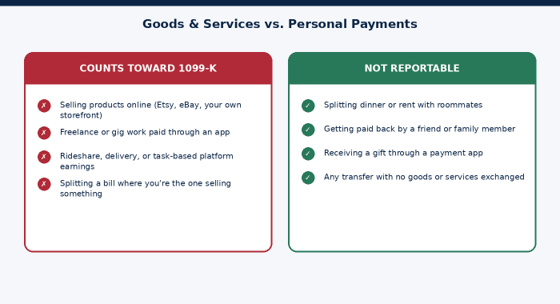
Per the IRS Form 1099-K FAQs — Common Situations, the reporting requirement applies only to payments for goods or services — not to personal transfers between friends and family.
The line between reportable business activity and ordinary personal transfers.
Most major payment apps now let users label transactions as personal versus business, which helps keep these separate. Still, mistakes happen — a friend labeling a dinner reimbursement as a “payment” rather than a personal transfer can occasionally get swept into a platform’s reporting totals, which is why reviewing any 1099-K received is worth the extra few minutes.
“I Didn't Get a 1099-K” Is Not a Defense
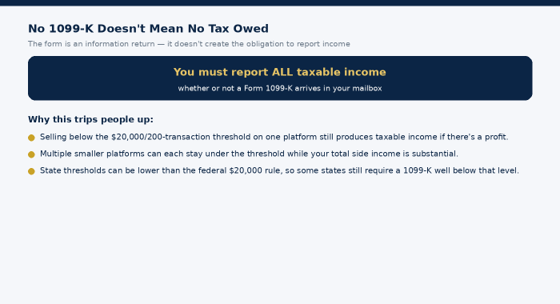
This is the single most important point in this entire guide. Per IRS Fact Sheet 2025-08, Form 1099-K is an information return — it exists to help the IRS cross-check reported income. It does not create the underlying obligation to report that income.
Every dollar of taxable income is reportable, form or no form.
This matters most for taxpayers who sell across several smaller platforms, none of which individually cross the $20,000/200-transaction line, while their combined side income is very real. It also matters because some states set lower 1099-K thresholds than the federal rule, so a form can still arrive even when federal thresholds aren’t met.
Selling Personal Items? There's a Special Rule
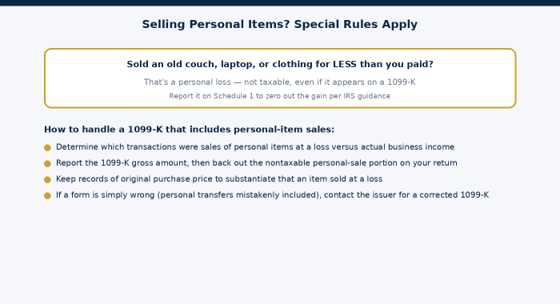
A common source of confusion: selling an old couch, laptop, or clothing on a marketplace app for less than you originally paid for it. Per the IRS Form 1099-K FAQs — Common Situations, that’s a personal loss, and personal losses are generally not deductible — but they’re also not taxable income, even if the sale shows up on a 1099-K.
Selling used personal items at a loss is not taxable — here's how to report it correctly
The IRS guidance directs taxpayers to report the 1099-K gross amount and then back out the nontaxable, personal-loss portion — commonly done on Schedule 1 (Form 1040) — rather than simply ignoring the form. If a 1099-K includes amounts that shouldn’t be there at all, such as mislabeled personal transfers, contact the issuing platform to request a corrected form.
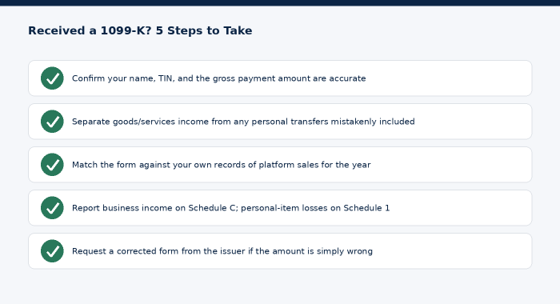
Received a 1099-K? Here's What to Do
A few minutes of review now prevents a mismatch notice later.
Check it against your own records
Compare the gross amount reported to your own log of sales or payments received on that platform. Discrepancies are common and worth resolving before filing.
Separate business income from personal-item sales
If the form blends legitimate business income with the sale of personal used items, both need to be handled differently on your return.
Report business income correctly
Self-employment and gig income generally belongs on Schedule C, where you can also deduct related business expenses against the gross amount shown on the 1099-K.
How can Liberty Tax Accounting help you
Liberty Tax Accounting helps gig workers, online sellers, and small business owners make sense of 1099-K forms, separate taxable income from personal transfers, and file accurately. Contact us today for a confidential review of your 1099-K.