IRS Audit Essentials: What Triggers One, What to Expect, and Your Rights in 2026
Few letters from the government cause more anxiety than one from the IRS Audit division. But most audits are far less dramatic — and far less common — than people assume. Understanding what actually triggers scrutiny, how the process works, and what rights protect you throughout can turn a stressful notice into a manageable process.
This guide breaks down the IRS Audit process for the 2026 tax season using the IRS’s own published guidance: realistic audit odds, the three types of audits, how far back the IRS can legally look, the Taxpayer Bill of Rights, and exactly what to do if a notice arrives.
How Likely Is an Audit, Really?
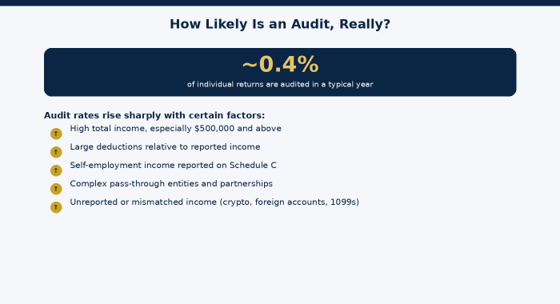
Audit rates are far lower than popular belief suggests. Individual audit rates have generally run under 0.5% of all returns filed in recent years, per IRS enforcement data referenced in the IRS Statistics of Income program. Most of these are simple correspondence audits resolved entirely by mail.
The baseline audit rate is low — certain factors push it much higher.
That said, the odds aren’t evenly distributed. Returns with higher total income, especially above $500,000, large deductions relative to reported income, self-employment income on Schedule C, complex pass-through entities, and data mismatches — including unreported cryptocurrency transactions now visible through Form 1099-DA — all draw a disproportionate share of examinations. The IRS has also significantly expanded its use of artificial intelligence and analytics tools to flag anomalies and prioritize higher-value cases, even as staffing levels have declined.
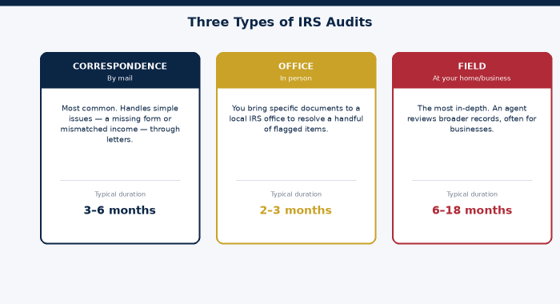
Correspondence audits are simplest; field audits are the most involved.
Most individual audits are handled entirely through correspondence — a letter requesting documentation for one or two specific items, resolved by mail. Office audits require an in-person meeting at a local IRS office over a limited set of issues. Field audits, the most extensive, involve an IRS agent visiting a home or business and are typically reserved for complex individual returns and virtually all business examinations.
How Far Back Can the IRS Go?
Per IRS Topic No. 305, Recordkeeping, the IRS’s authority to examine a return isn’t unlimited — but the standard window is shorter than many taxpayers assume it should be relied upon for older records.
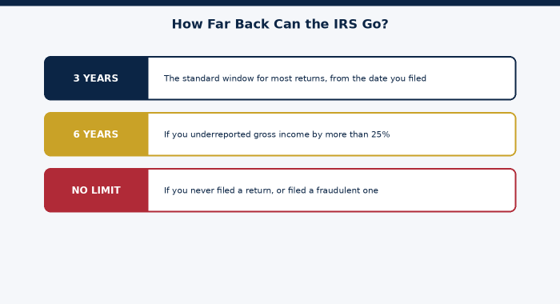
The audit window extends sharply for underreported income or unfiled returns
The standard period of limitations is 3 years from the date a return was filed. That extends to 6 years if unreported income exceeds 25% of the gross income shown on the return, and there is no time limit at all for returns that were never filed or that the IRS determines were fraudulent. Because of this, the IRS generally recommends keeping supporting records for at least three years, and longer in situations involving property, bad debt losses, or worthless securities.
Your Rights During an Audit
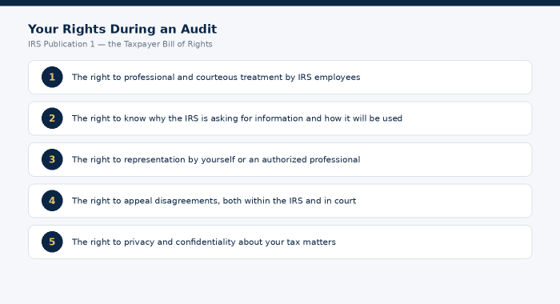
Every taxpayer under examination is protected by the Taxpayer Bill of Rights, detailed in IRS Publication 1, Your Rights as a Taxpayer. These rights apply throughout the entire examination, appeal, and collection process.
Five of the ten core rights that apply throughout an audit.
Perhaps the most practical of these is the right to representation — you are never required to meet with an IRS examiner in person on your own. An authorized representative such as a CPA, enrolled agent, or attorney can communicate with the IRS and, in many cases, attend meetings on your behalf. The full list of ten rights, along with the IRS Audits information page, explains how the IRS selects returns and what happens at each stage.
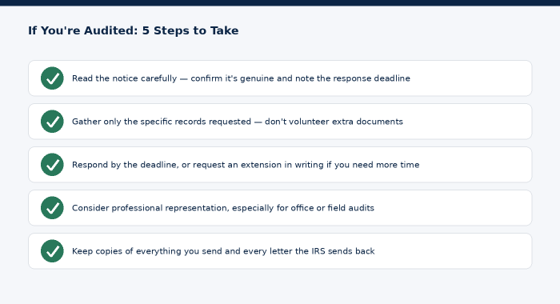
If You're Audited: What to Do First
A calm, organized response shortens most audits.
Confirm the notice is legitimate
The IRS almost always initiates contact by mail, never by unsolicited phone call, text, or email demanding immediate payment. If in doubt, verify a notice by calling the number on IRS.gov’s understanding your notice page rather than a number printed only in the letter itself.
Gather exactly what's requested
Per Publication 3498, providing organized, relevant documentation for the specific items in question — without volunteering unrelated records or tax years — is the fastest path to a favorable resolution.
Respond by the deadline
Missing a response deadline can result in the IRS proposing changes without your input. If more time is genuinely needed, request an extension in writing before the deadline passes.
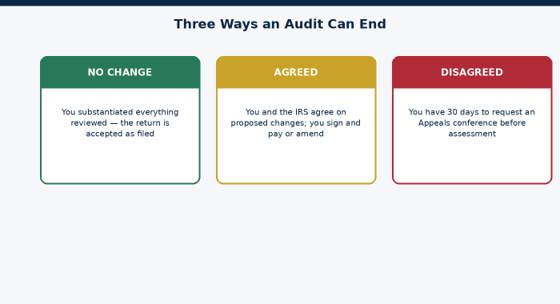
A disagreement isn't the end — Appeals is a formal next step, not a last resort.
A no change result means every item examined was fully substantiated. An agreed outcome means you and the IRS reach consensus on adjustments, which you sign off on. In a disagreed case, you generally have 30 days from the examination report to request a conference with the IRS Independent Office of Appeals before any additional tax is formally assessed.
How can Liberty Tax Accounting help you
Liberty Tax Accounting represents individuals and businesses through every stage of an IRS audit, from the first notice through Appeals if needed. Contact us today for a confidential review of your audit notice.