
Business Deductions Explained: The Complete 2026 Tax Season Guide

Few things move the needle on a business’s tax bill more than business deductions — and few areas of the tax code change as often. For 2026, the One Big Beautiful Bill Act (OBBBA) has permanently reshaped some of the biggest write-offs available to business owners, from equipment expensing to the deduction on pass-through income.
This guide breaks down business deductions for the 2026 tax season using the IRS’s own published guidance: what qualifies as deductible in the first place, the new Section 179 and bonus depreciation numbers, a rare mid-year mileage rate change, the QBI deduction, and the recordkeeping rules that protect every write-off you claim.
What Actually Qualifies as a Business Deduction?
Per IRS Publication 535, Business Expenses, a business expense is deductible if it is both ordinary — common and accepted in your trade or business — and necessary — helpful and appropriate for your business. An expense doesn’t have to be indispensable to be considered necessary.
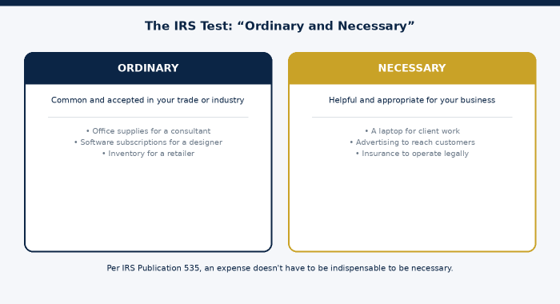
This test applies broadly — office supplies, software subscriptions, advertising, insurance, and inventory all typically qualify, provided the expense relates directly to running the business and isn’t a personal cost. Mixed-use expenses, like a vehicle or home office used for both business and personal purposes, must be allocated based on the actual business-use percentage.
Section 179 and Bonus Depreciation: The 2026 Numbers
Equipment, vehicles, software, and other business property are usually deducted gradually through depreciation. Two provisions let you accelerate much or all of that deduction into the year you buy the asset. Per IRS Revenue Procedure 2025-32, the 2026 limits are:
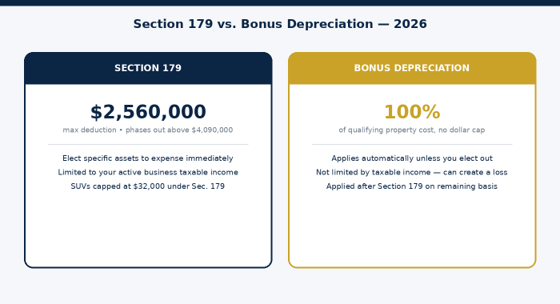
The Section 179 deduction allows you to expense up to $2,560,000 of qualifying property in 2026, with the deduction phasing out dollar-for-dollar once total qualifying purchases exceed $4,090,000. Unlike bonus depreciation, Section 179 cannot create or increase a business loss — it’s capped at your active trade or business taxable income for the year, though disallowed amounts can generally carry forward.
Per the IRS OBBBA depreciation guidance, bonus depreciation was permanently restored to 100% for qualifying property acquired and placed in service after January 19, 2025. It has no dollar cap and isn’t limited by taxable income, meaning it can create a net operating loss that carries forward. The IRS requires Section 179 to be applied first, with bonus depreciation covering the remaining basis.
Vehicle Deductions: A Rare Mid-Year Mileage Rate Change
For 2026, the IRS did something it rarely does: it changed the standard mileage rate mid-year. Per the IRS 2026 standard mileage rate announcement and a follow-up mid-year adjustment, the business rate started the year at 72.5 cents per mile and increased to 76 cents per mile for the second half of the year, citing rising vehicle operating costs.
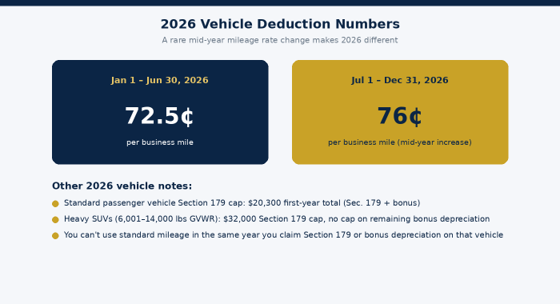
This means mileage logs need to separate trips taken before and after July 1, 2026, when calculating the deduction. As always, per IRS Topic No. 510, Business Use of Car, you must choose between the standard mileage rate and actual expenses in the first year a vehicle is placed in service, and you cannot use the standard mileage rate in any year you’ve claimed Section 179 or bonus depreciation on that same vehicle.
The QBI Deduction: Up to 20% Off Pass-Through Income
Sole proprietors, partners, and S corporation shareholders may also qualify for the Qualified Business Income (QBI) deduction under Section 199A, worth up to 20% of qualified business income — on top of ordinary business deductions. Per the IRS Qualified Business Income Deduction page, this deduction was made a permanent part of the tax code by the OBBBA.

For 2026, the taxable income thresholds where wage and capital limitations — and restrictions for specified service trades or businesses — begin to phase in are $201,750 for single and head of household filers and $403,500 for those married filing jointly, per Revenue Procedure 2025-32. New for 2026, taxpayers with at least $1,000 of active qualified business income are guaranteed a minimum QBI deduction of $400, even if 20% of their income would otherwise produce a smaller number.
Commonly Overlooked Business Deductions
Home office
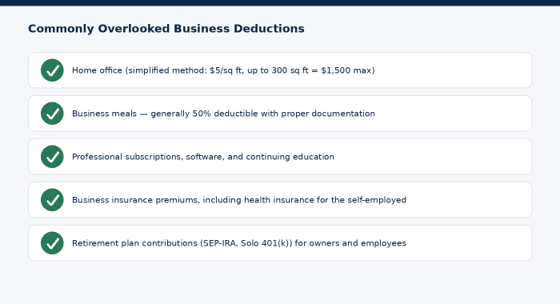
The IRS simplified home office method allows $5 per square foot of dedicated business space, up to 300 square feet, for a maximum deduction of $1,500 — with no need to track actual utility or maintenance costs. The space must be used regularly and exclusively for business.
Business meals
Per IRS Publication 463, business meals are generally 50% deductible when they have a clear business purpose and aren’t lavish or extravagant under the circumstances. Keep the receipt and note who attended and what business was discussed.
Professional development and subscriptions
Software, professional memberships, industry publications, and continuing education directly related to maintaining or improving skills used in your current business are generally deductible.
Retirement plan contributions
Contributions to a SEP-IRA or Solo 401(k) reduce taxable business income while building retirement savings, and are among the largest deductions available to profitable self-employed taxpayers and small business owners.
No Records, No Deduction
Every deduction claimed on a return can be challenged, and per IRS Publication 583, Starting a Business and Keeping Records, the burden of proof for substantiating a deduction rests with the taxpayer, not the IRS.
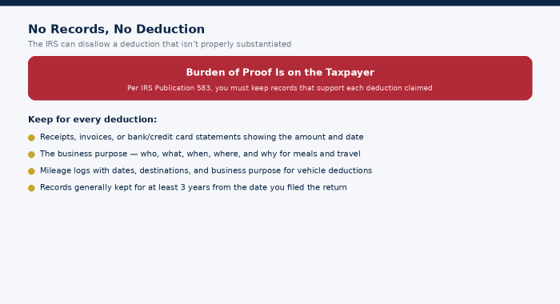
At minimum, keep receipts or statements showing the amount and date of each expense, documentation of the business purpose, and mileage logs for vehicle use. Records should generally be retained for at least three years from the date the return was filed, though longer retention is wise for large equipment purchases subject to depreciation recapture.
How can Liberty Tax Accounting help you
Liberty Tax Accounting helps business owners identify every deduction they’re entitled to, apply Section 179 and bonus depreciation strategically, and keep documentation audit-ready. Contact us today for a confidential review of your 2026 business deductions.