
Payroll Tax Essentials: What Employers Need to Know for the 2026 Tax Season
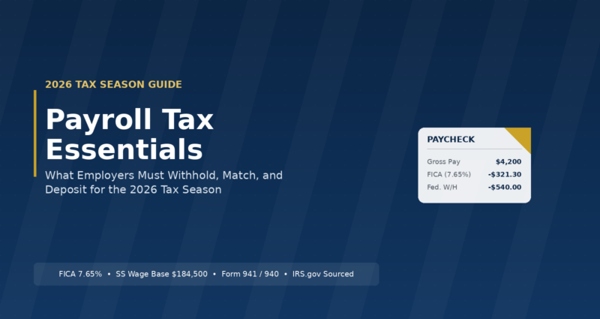
If you run payroll for even one employee, you’re responsible for payroll tax — a set of federal withholding and matching obligations that are easy to get wrong and expensive to get wrong badly. For the 2026 tax season, the Social Security wage base has increased, deposit rules remain strict, and the penalties for mishandling withheld taxes are some of the harshest in the entire tax code.
This guide breaks down payroll tax for employers using the IRS’s own published guidance: what makes up your payroll tax obligation, the key 2026 numbers, which forms report what, and the deposit rules that keep a business out of trouble.
What Actually Counts as Payroll Tax
“Payroll tax” isn’t a single tax — it’s a bundle of federal withholding and employment tax obligations that apply every time you run payroll. Per the IRS Employment Taxes page, employers are generally responsible for withholding federal income tax, withholding and matching Social Security and Medicare tax (together known as FICA), and paying Federal Unemployment Tax (FUTA) on top.
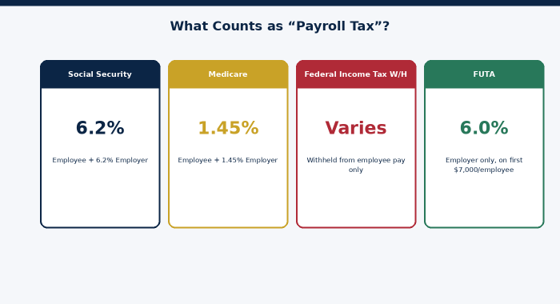
Social Security and Medicare tax are split evenly between employer and employee — each pays 6.2% for Social Security and 1.45% for Medicare, for a combined 15.3%. Federal income tax withholding, by contrast, comes entirely out of the employee’s pay based on their Form W-4 elections. FUTA is the only piece paid solely by the employer, with no employee withholding at all.
The Key 2026 Payroll Tax Numbers
The core FICA tax rates are unchanged for 2026, but the Social Security wage base — the maximum amount of wages subject to Social Security tax each year — has increased. Per the Social Security Administration’s 2026 fact sheet, referenced in IRS payroll guidance, the wage base rises to $184,500 for 2026, up from $176,100 in 2025.
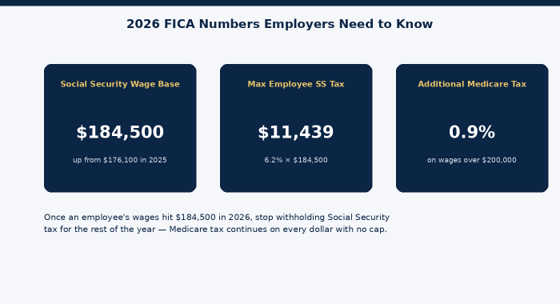
Once an employee’s cumulative wages hit $184,500 in 2026, stop withholding Social Security tax for the rest of the calendar year — both the employee withholding and your employer match stop at that point. Medicare tax, however, applies to every dollar of wages with no cap, and per IRS Topic No. 751, employers must withhold an additional 0.9% Medicare surtax once an employee’s wages exceed $200,000 in the year — regardless of the employee’s filing status.
Form 941 vs. Form 940: Two Very Different Filings
Payroll tax compliance runs on two core federal forms, and confusing them is one of the most common employer mistakes.
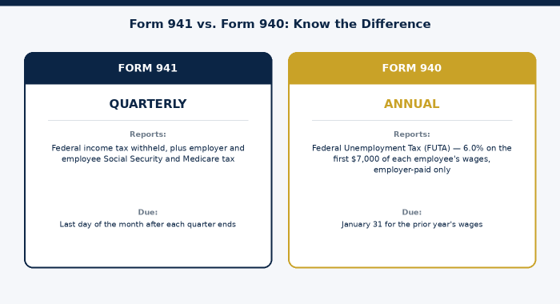
Per the IRS Instructions for Form 941, most employers file this return quarterly to report wages paid, federal income tax withheld, and both the employer and employee shares of Social Security and Medicare tax. Very small employers may instead qualify to file Form 944 annually if notified by the IRS.
Separately, per IRS Topic No. 759, Form 940 reports Federal Unemployment Tax at a statutory rate of 6.0% on the first $7,000 of each employee’s wages. Employers who pay state unemployment tax in full and on time typically receive a credit of up to 5.4%, reducing the effective FUTA rate to just 0.6% — a maximum of $42 per employee per year.
Deposits Aren't Optional — And the Penalty Is Personal
The money withheld from employee paychecks for federal income tax and FICA is legally considered trust fund money — it belongs to the government the moment it’s withheld, not to the business. Per the IRS Trust Fund Recovery Penalty page, any responsible person who willfully fails to collect, account for, or deposit these taxes can be held personally liable for a penalty equal to 100% of the unpaid trust fund taxes — separate from and in addition to the business’s own liability.
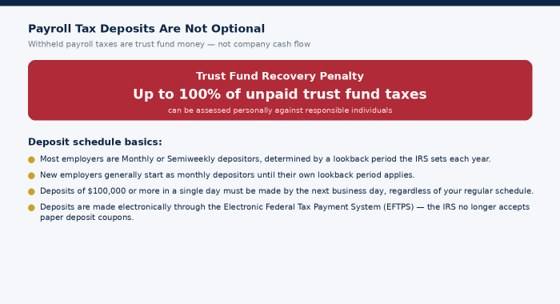
Per the IRS Publication 15 (Circular E), most employers are classified as either monthly or semiweekly depositors based on a look back period the IRS reviews annually, and deposits must be made electronically through the Electronic Federal Tax Payment System (EFTPS). A single-day accumulation of $100,000 or more in payroll tax liability triggers a next-business-day deposit requirement, regardless of your normal schedule.
Common Payroll Tax Mistakes to Avoid
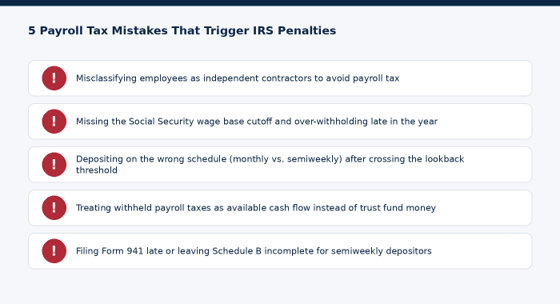
1. Worker misclassification
Treating an employee as an independent contractor to avoid payroll tax is one of the fastest ways to trigger an IRS audit. See the IRS Employee vs. Independent Contractor guidance for the factors the IRS applies.
2. Missing the Social Security wage base cutoff
Payroll systems that aren’t updated for the new $184,500 threshold can either over-withhold late in the year or, worse, under-withhold if last year’s figure was never updated.
3. Depositing on the wrong schedule
Your deposit schedule can change year to year based on the IRS lookback period. Confirming your schedule every January prevents late-deposit penalties.
4. Spending withheld taxes as cash flow
Trust fund taxes must be set aside, not used to cover payroll gaps or operating expenses — doing so is exactly the scenario the Trust Fund Recovery Penalty targets.
5. Incomplete or late Form 941 filings
Semiweekly depositors must also complete Schedule B, which itemizes tax liability by deposit date. A mismatch between Schedule B and actual deposits is a common source of IRS notices.
How can Liberty Tax Accounting help you
Liberty Tax Accounting helps businesses manage payroll tax withholding, deposits, and quarterly and annual filings accurately and on time. Contact us today for a confidential review of your payroll tax compliance.