Sales Tax for Online Businesses: The 2026 Guide to Nexus, Marketplaces, and Compliance
If you sell products online — through your own storefront, Amazon, Etsy, or all three — sales tax is probably one of the most confusing parts of running an e-commerce business. Unlike federal income tax, sales tax is governed by each individual state, and the rules for when you owe it changed dramatically after a 2018 Supreme Court decision.
This guide covers sales tax for online businesses heading into the 2026 tax season: what economic nexus means, how marketplace facilitator laws shift responsibility, and where federal reporting forms like the 1099-K fit into the picture.
Sales Tax and Income Tax Are Not the Same Thing
Many online sellers lump “taxes” into one category, but federal income tax and state sales tax are entirely separate systems with different agencies, different rules, and different deadlines. Your federal income tax is based on your business profit and is reported to the IRS via Schedule C (for sole proprietors) alongside your personal or business return. Sales tax, on the other hand, is charged on each taxable sale to a customer and is collected and remitted to state — not federal — tax authorities.
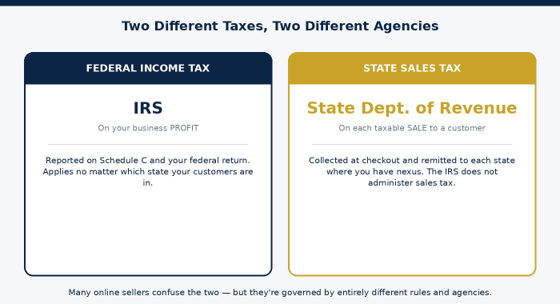
Because the IRS does not administer sales tax, there’s no single federal “sales tax page” to check. Instead, each state’s Department of Revenue sets its own rates, thresholds, and filing calendar — and the Streamlined Sales Tax Governing Board maintains a directory of participating states’ rules for multi-state sellers.
Economic Nexus: The Rule That Changed Everything for Online Sellers
Before 2018, a business generally only had to collect sales tax in states where it had a physical presence — an office, warehouse, or employees. That changed with South Dakota v. Wayfair, Inc., a landmark Supreme Court ruling that allowed states to require out-of-state sellers to collect sales tax based purely on economic activity in that state, even with zero physical presence.
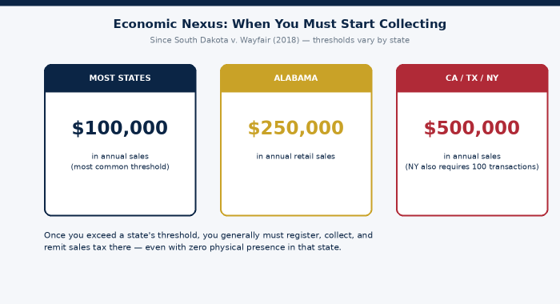
Most states set their economic nexus threshold at $100,000 in annual sales, though several states use higher figures or add a transaction-count test. Because every state sets its own rule, a fast-growing online seller can trigger a filing obligation in a state where they’ve never shipped a single package in person. The U.S. Small Business Administration advises new business owners to check state and local tax requirements as part of standard tax compliance — sales tax registration is typically handled through each state’s own Department of Revenue website.
Marketplace Facilitator Laws: Who Actually Collects the Tax?
If you sell through a marketplace like Amazon, Etsy, eBay, or Walmart, you may not need to collect sales tax yourself at all. Under marketplace facilitator laws, nearly every state with a sales tax now requires the marketplace — not the individual seller — to calculate, collect, and remit sales tax on transactions made through their platform.
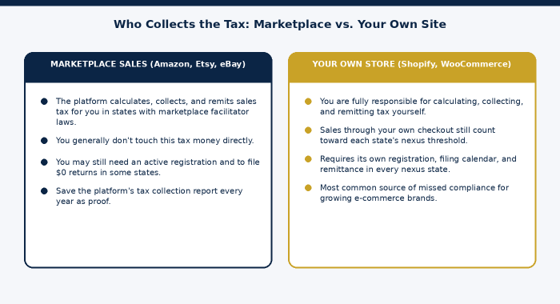
This shift simplifies compliance for marketplace-only sellers, but it comes with two important catches. First, a marketplace collecting tax does not automatically end your registration or filing duties in every state — some still expect an active permit and periodic returns even at $0 tax due. Second, if you sell through your own website or storefront in addition to a marketplace, those direct sales are entirely your responsibility to track, collect, and remit — and they still count toward your economic nexus threshold in each state.
Don't Confuse Form 1099-K With Sales Tax
Every filing season, online sellers ask whether their Form 1099-K has anything to do with sales tax. It doesn’t. Per the IRS page on Form 1099-K, this form reports gross payments processed through third-party platforms — PayPal, Stripe, Shopify Payments, and similar services — for federal income tax purposes only.
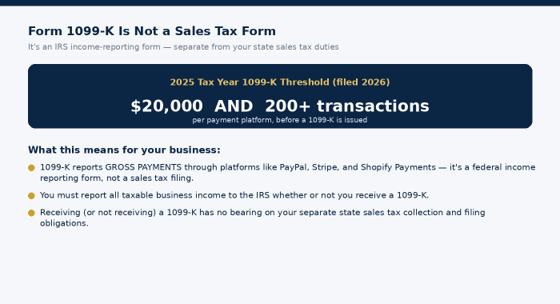
For the 2025 tax year (filed in 2026), a third-party settlement organization generally must issue Form 1099-K only when a seller exceeds $20,000 in gross payments and more than 200 transactions on that platform — a threshold restored by recent federal legislation. Whether or not you receive this form, the IRS reminds taxpayers that all taxable business income must still be reported. And separately, whether or not a marketplace or payment processor sends you any tax form, your state sales tax registration and filing duties continue on their own schedule.
A 5-Step Sales Tax Compliance Checklist for 2026
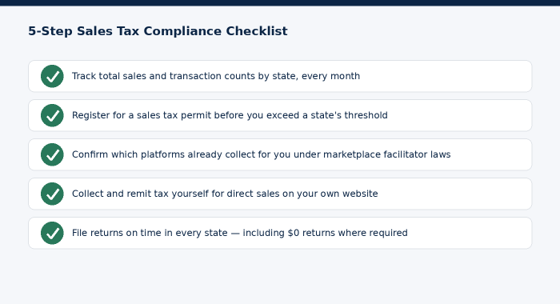
1. Track sales by state every month
Economic nexus is measured on a rolling or calendar-year basis depending on the state. Waiting until year-end to check your numbers risks missing a threshold retroactively.
2. Register before you cross a threshold
Most states expect registration at or near the point you exceed their nexus threshold — not months later. Late registration can trigger back taxes, penalties, and interest.
3. Confirm what your marketplaces already handle
Pull each platform’s tax collection report annually. Don’t assume — verify which states each marketplace is actively collecting and remitting for on your behalf.
4. Handle direct sales separately
Sales through your own Shopify or WooCommerce store are not covered by any marketplace’s facilitator collection. You need your own registration and remittance process for these.
5. File on time, including $0 returns
Many states still require a periodic return even when a marketplace collected all the tax due. Missing a required $0 return can still generate a notice or penalty in some states.
How can Liberty Tax Accounting help you
Liberty Tax Accounting helps e-commerce and online businesses run nexus reviews, register in the states where they owe sales tax, and stay current on marketplace facilitator and direct-sale filing obligations. Contact us today for a confidential review of your multi-state sales tax exposure.