IRA Withdrawals: Essential 2026 Tax Guide | Liberty Tax Accounting
A practical guide to traditional and Roth distributions, early-withdrawal rules, required minimum distributions and tax reporting.
IRA Withdrawals: what to know for the 2026 tax season
IRA Withdrawals made during 2025 are generally reported on the federal return you prepare in the 2026 tax season. The IRS opened the 2026 filing season on January 26, 2026, and the original deadline for most calendar-year taxpayers to file and pay their 2025 federal taxes was April 15, 2026. Before filing, review every retirement-account distribution and the tax form issued by the custodian.
The IRS’s primary source for this topic is Publication 590-B, Distributions from Individual Retirement Arrangements (IRAs).
Start with the type of IRA withdrawal
Not all IRA withdrawals are taxed the same way. A distribution from a traditional IRA is generally taxable in the year you receive it, unless a rule such as a qualifying rollover or basis calculation changes the result. A Roth IRA distribution can be tax-free when it is a qualified distribution, but the tax result depends on the Roth five-year rule and the nature of the payment.
Traditional IRA distributions
Traditional IRA distributions are generally included in gross income. If you ever made nondeductible traditional IRA contributions or rolled after-tax amounts into a traditional IRA, part of a distribution may be nontaxable. Do not assume that only one IRA account matters: the IRS’s basis rules can require a calculation across traditional IRA balances.
If you have basis from nondeductible contributions, Form 8606 is the form used to report relevant traditional IRA distributions, conversions and Roth IRA distributions.
Roth IRA distributions
For a Roth IRA, a qualified distribution must meet the five-year requirement and be made after you reach age 59½, because of disability, after death, or under the limited first-home rule. The first-home exception is subject to a $10,000 lifetime limit. Roth IRA ordering rules and conversion history can affect a distribution that is not qualified, so do not label every Roth withdrawal tax-free without checking the facts.
Roth IRA owners are not required to take lifetime required minimum distributions. However, distribution rules can change after the owner’s death, so beneficiaries should obtain tailored guidance.
Early IRA Withdrawals can create two tax costs
An early distribution is generally one taken before age 59½. For a taxable early traditional IRA distribution, the usual result can be regular income tax plus a 10% additional tax. That extra tax is separate from the income tax on the withdrawal, and the IRA custodian’s Form 1099-R code does not always settle whether an exception applies.
The IRS lists exceptions to the additional tax in its early-distribution exception chart. Examples include certain unreimbursed medical expenses, health insurance while unemployed, qualified higher-education expenses and first-home expenses, when the applicable requirements are met.
Required minimum distributions (RMDs) are different from optional withdrawals
Traditional IRA owners generally must begin taking required minimum distributions for the year they reach age 73. You can delay the first RMD until April 1 of the following year, but delaying the first payment can mean taking two taxable distributions in that following calendar year. Subsequent RMDs are generally due by December 31 each year.
The IRS explains the timing and calculation approach in its RMD FAQs. RMD calculations generally use the prior December 31 account balance and the applicable IRS life-expectancy factor.
An inherited IRA can follow different distribution rules based on the beneficiary and the date of the owner’s death. Treat an inherited account as its own planning question rather than applying your own IRA rules automatically.
A charitable option for eligible IRA owners
A qualified charitable distribution (QCD) is generally a nontaxable distribution paid directly by the IRA trustee to an eligible charitable organization. To use a QCD, you generally must be at least age 70½ when the distribution is made. For 2025, the maximum annual QCD exclusion is $108,000 per eligible taxpayer, subject to the IRS rules.
Publication 590-B explains QCD eligibility, direct-payment requirements and reporting. Review the IRS QCD guidance before treating a charitable payment as a QCD. A QCD that is excluded from income cannot also be claimed as a charitable contribution deduction.
Tax forms to review before you file
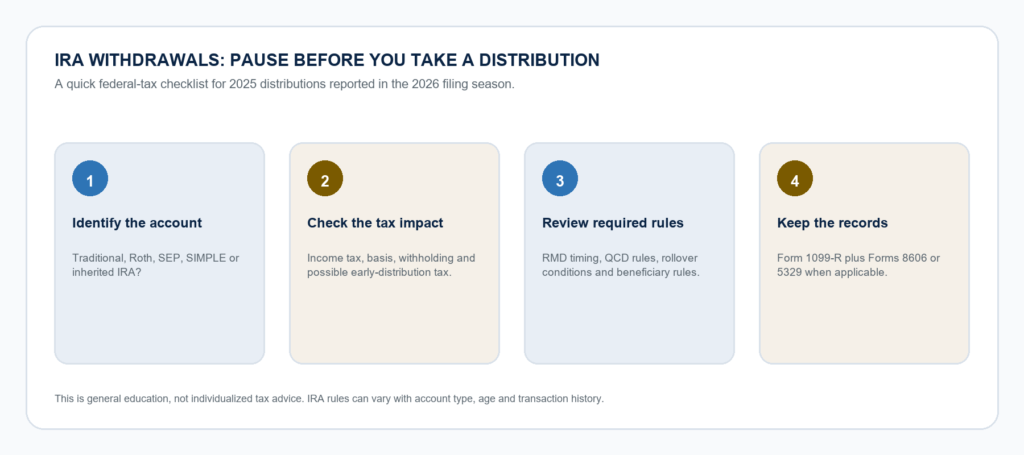
Your IRA custodian generally issues Form 1099-R for a reportable distribution. Review the gross distribution, taxable amount, tax withholding and distribution code, then compare the form with your records. A 1099-R is important, but it may not show every fact required to determine whether an exception or basis calculation applies.
| Form | When It Can Matter | Why It Matters |
|---|---|---|
| Form 1099-R | Issued when you receive a reportable IRA distribution or another qualifying retirement account distribution or transaction. | Reports the distribution amount, federal and state tax withholding (if any), and distribution codes used by the IRA custodian to report the transaction to the IRS. |
| Form 8606 | Required if you have basis from nondeductible traditional IRA contributions, complete certain Roth conversions, or report certain Roth IRA distributions. | Helps determine which portion of an IRA distribution or conversion is taxable and which portion is nontaxable under IRS rules. |
| Form 5329 | May apply when an early IRA distribution is subject to an additional tax or when you qualify for an IRS exception to that additional tax. | Used to calculate, report, or claim exceptions to the additional tax on early distributions and certain other retirement account taxes. |
Before you take an IRA withdrawal
The best time to assess an IRA distribution is before the money leaves the account. Reviewing the purpose of the withdrawal, the tax treatment, the available exception or rollover rules, withholding and the impact on your broader return can help prevent surprises at filing time.
Planning IRA Withdrawals before the distribution date gives you more room to compare options and avoid an unintended reporting issue.
- Confirm the exact account type and whether the withdrawal is from your own IRA or an inherited IRA.
- Estimate the ordinary income, withholding and potential 10% additional tax before spending the funds.
- Check whether a direct rollover or another permitted transaction is more appropriate than a cash distribution.
- Gather prior Forms 8606 if you have ever made nondeductible traditional IRA contributions.
- Review RMD timing if you are near or over the required beginning age.
- Keep your Form 1099-R and the records that support any exception, rollover, basis calculation or QCD.
If you need help with IRA Withdrawals, contact Liberty Tax Accounting. Our team can help you review Forms 1099-R, understand the tax impact of traditional and Roth distributions, evaluate documentation for exceptions or basis, and prepare a filing strategy that fits your situation. Reach out for support with retirement distributions or any other tax question affecting your return.