
Child Tax Credit (CTC) 2026
Complete IRS Guide - Eligibility, Income Limits, Refund Rules & Common Mistakes

For 2025 federal income tax returns filed during the 2026 tax season
A qualifying child must generally be under age 17 at the end of 2025, meet relationship, residency, support, dependency, joint-return, citizenship/residency, and Social Security number requirements.
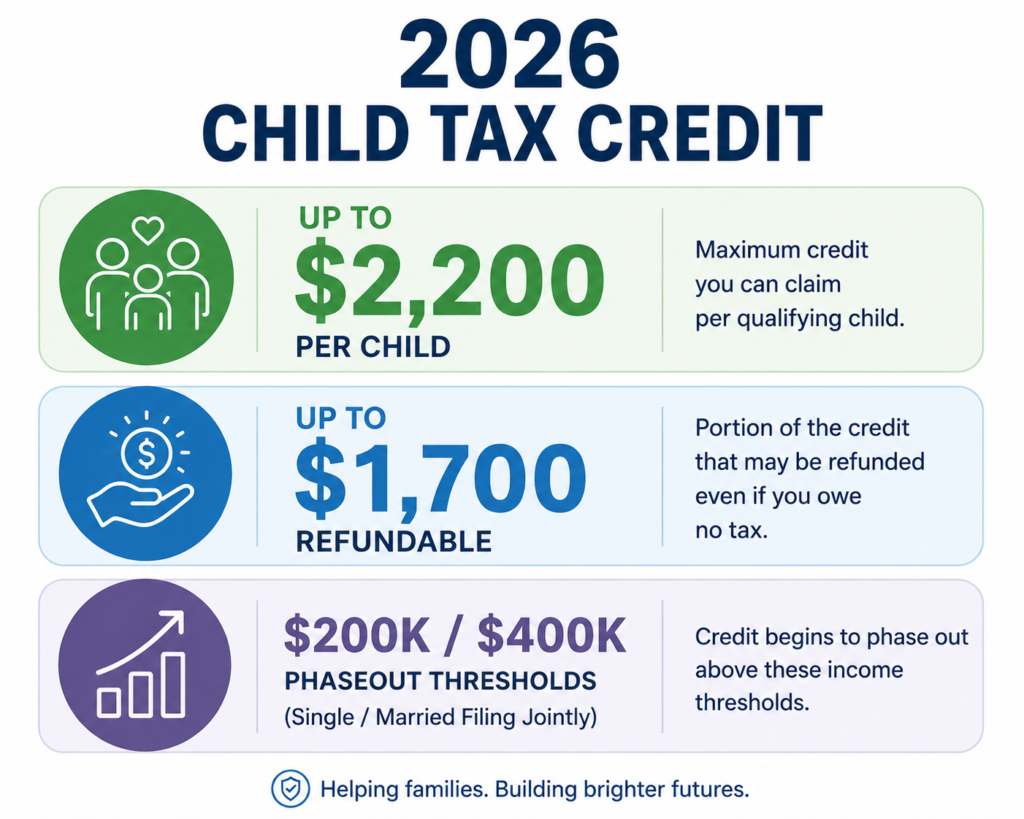
The full credit begins to phase out above modified adjusted gross income of $200,000 for most filers and $400,000 for married couples filing jointly.
The ACTC can be refundable, but eligibility is not automatic. The IRS states that taxpayers need at least $2,500 of earned income to be eligible for ACTC, subject to the Schedule 8812 calculation and other rules.
A refund that includes ACTC generally cannot be issued before mid-February under federal law, and the delay applies to the entire refund.
What is the Child Tax Credit?
The Child Tax Credit (CTC) is a federal income-tax credit for taxpayers with qualifying children. It first reduces federal income tax liability. If a taxpayer is eligible for the refundable portion, part of the credit may be claimed as the Additional Child Tax Credit (ACTC).
For the 2025 tax year, which most individual taxpayers file in 2026, the maximum CTC is $2,200 per qualifying child. The credit can be reduced by income-based phaseout rules, and the amount that is refundable is limited by separate ACTC rules.
Official sources: IRS Child Tax Credit;
2026 CTC amounts at a glance
| Item | 2025 Return / 2026 Filing Season Rule | Why It Matters |
|---|---|---|
| Maximum Child Tax Credit (CTC) | $2,200 for each qualifying child | The credit may reduce your federal income tax, subject to income limits and other IRS eligibility rules. |
| Maximum Refundable ACTC | Up to $1,700 for each qualifying child | Refundability is determined using Schedule 8812 calculations and other IRS requirements. |
| ACTC Earned Income Threshold | At least $2,500 of earned income | Meeting the earned income threshold alone does not guarantee a refundable credit. |
| Phaseout Threshold |
$200,000 MAGI (Single, Head of Household, Married Filing Separately) $400,000 MAGI (Married Filing Jointly) |
The Child Tax Credit begins to phase out when modified adjusted gross income exceeds the applicable threshold. |
| Refund Timing | ACTC-related refunds are generally not issued before mid-February. | By law, the IRS must hold the taxpayer's entire refund if it includes the Additional Child Tax Credit. |
Who qualifies: the seven-part child test
A child must satisfy all applicable requirements to be a qualifying child for the CTC. The following list is a plain-English summary; Schedule 8812, the IRS CTC page, and the dependency rules control.
1. Age test
The child must be under age 17 at the end of the tax year. For a 2025 return, the child must be under age 17 on December 31, 2025.
Official source: IRS Child Tax Credit.
2. Relationship test
The child must be your son, daughter, stepchild, eligible foster child, brother, sister, stepbrother, stepsister, half-brother, half-sister, or a descendant of one of those individuals, such as a grandchild, niece, or nephew.
Official source: IRS Child Tax Credit.
3. Residency test
The child must have lived with you for more than half of the tax year. The IRS dependency rules include exceptions and special treatment for certain temporary absences, so retain records when the child was away for school, medical care, military service, or a similar temporary reason.
Official sources: IRS Child Tax Credit;
Publication 501, Dependents, Standard Deduction, and Filing Information.
4. Support test
The child must not have provided more than half of their own support during the tax year.
Official source: IRS Child Tax Credit.
5. Dependent test
You must claim the child as a dependent on your federal income tax return. Dependency rules and tiebreaker rules can determine which taxpayer is entitled to claim a child when more than one person may be eligible.
Official sources: IRS Child Tax Credit;
Publication 501.
6. Joint-return test
Generally, the child cannot file a joint return for the year. An exception applies if the joint return was filed only to claim a refund of withheld income tax or estimated tax paid.
Official source: IRS Child Tax Credit.
7. Citizenship or residency test
The child must be a U.S. citizen, U.S. national, or U.S. resident alien.
Official source: IRS Child Tax Credit.
Social Security number requirements
For a 2025 return, you, and your spouse if filing jointly, must meet the valid Social Security number (SSN) rules to claim CTC or ACTC. A qualifying child must have an SSN valid for employment in the United States that was issued before the due date of the return, including extensions.
For married taxpayers filing jointly, only one spouse is required to have a valid SSN for CTC/ACTC eligibility. The other spouse must have either an SSN or an ITIN issued on or before the return’s due date, including extensions. These details were specifically updated in the 2025 Schedule 8812 instructions.
A child with only an ITIN generally does not qualify as a qualifying child for CTC/ACTC. Depending on the facts, the taxpayer may instead consider the Credit for Other Dependents, which carries different eligibility rules and a maximum amount of $500 per eligible dependent.
Official sources: 2025 Schedule 8812 instructions;
IRS Child Tax Credit.
Income limits and phaseout
The full CTC is generally available when modified adjusted gross income (MAGI) does not exceed $200,000, or $400,000 for married taxpayers filing jointly. Above the applicable threshold, the credit is reduced by $50 for each $1,000, or fraction of $1,000, of MAGI over the threshold.
| Filing Situation | CTC Phaseout Threshold | Reduction Rule |
|---|---|---|
| Most Filing Statuses | $200,000 Modified Adjusted Gross Income (MAGI) | The Child Tax Credit is reduced by $50 for each $1,000, or part of $1,000, above the threshold. |
| Married Filing Jointly | $400,000 Modified Adjusted Gross Income (MAGI) | The Child Tax Credit is reduced by $50 for each $1,000, or part of $1,000, above the threshold. |
Official sources: IRS Child Tax Credit;
Refundable Additional Child Tax Credit 2026 (ACTC)
The ACTC is the refundable part of the CTC. A refundable credit can increase a refund even when the taxpayer’s federal income tax liability is less than the credit amount. The ACTC is not simply the unused CTC: taxpayers must complete Schedule 8812 and satisfy the applicable rules.
For tax year 2025, up to $1,700 per qualifying child may be refundable. The IRS states that taxpayers must have at least $2,500 of earned income to be eligible for the ACTC. The actual amount depends on the Schedule 8812 calculation, including the taxpayer’s circumstances and applicable limits.
Official sources: IRS Child Tax Credit;
2025 Schedule 8812 instructions.
CTC, ACTC, and Credit for Other Dependents: a quick comparison
| Credit | Who It Is For | Maximum Credit for 2025 | Refundable? |
|---|---|---|---|
| Child Tax Credit (CTC) | Taxpayers with a qualifying child who meets all IRS Child Tax Credit requirements. | $2,200 per qualifying child | ❌ No. It first reduces your federal income tax liability. |
| Additional Child Tax Credit (ACTC) | Eligible taxpayers who qualify for the refundable portion of the Child Tax Credit under IRS rules. | Up to $1,700 per qualifying child | ✅ Yes. Subject to IRS eligibility requirements and Schedule 8812 calculations. |
| Credit for Other Dependents (ODC) | Certain dependents who do not qualify for the Child Tax Credit or Additional Child Tax Credit. | Up to $500 per eligible dependent | ❌ No. This credit is nonrefundable. |
When ACTC refunds may arrive
Federal law requires the IRS to hold refunds that include the ACTC until at least mid-February. This is commonly called the PATH Act refund hold. The delay applies to the entire refund, not only the portion associated with ACTC.
The IRS advises taxpayers to check Where’s My Refund for a personalized status; the tool updates once per day. Filing early does not override the statutory hold.
How to claim the credit
Most taxpayers claim the CTC, ACTC, or ODC by completing Form 1040 or Form 1040-SR and attaching Schedule 8812, Credits for Qualifying Children and Other Dependents. The Schedule 8812 instructions explain how to calculate the available credit and where to report it.
Confirm each child’s name, Social Security number, and date of birth match Social Security Administration records.Review the qualifying-child rules, especially residency, support, dependency, and joint-return status.Enter dependent information on Form 1040 and complete the applicable parts of Schedule 8812.Retain supporting records. Do not submit extra documents with an e-filed return unless the IRS or your tax software specifically requires them.
Use current IRS instructions for the return year; forms and amounts can change.
Official sources: About Schedule 8812;
2025 Schedule 8812 instructions.
Special situations: divorced and separated parents
Only one taxpayer may claim a child as a dependent for a tax year. In some cases, special rules allow a noncustodial parent to claim certain child-related benefits when the custodial parent releases the dependency claim using Form 8332 or a substantially similar statement. The applicability of CTC, dependency benefits, and other credits must be reviewed carefully because different benefits can follow different rules.
Do not assume that a private agreement or alternating-year arrangement alone controls the federal tax result. Review the applicable IRS dependency and Form 8332 guidance before filing.
Official source: Publication 501.
Common Child Tax Credit 2026 mistakes to avoid
| Common Issue | Why It Can Cause a Problem | Better Practice |
|---|---|---|
| Child Turned 17 During the Tax Year | The child must be under age 17 at the end of the tax year to qualify for the Child Tax Credit. | Verify the child's age as of December 31 of the tax year before claiming the credit. |
| Missing or Late Social Security Number (SSN) | The qualifying child must have a valid SSN that meets IRS issuance requirements. | Confirm the child's SSN and ensure it was issued by the applicable filing deadline. |
| Wrong Taxpayer Claims the Child | Only the taxpayer who is eligible to claim the child as a dependent may claim the Child Tax Credit. IRS tiebreaker rules may apply. | Resolve dependency questions before filing and keep documentation supporting the claim. |
| Residency Records Are Unclear | The child generally must have lived with the taxpayer for more than half of the year. | Maintain school, medical, daycare, lease, or other records if residency could be questioned. |
| Assuming ACTC Equals the Unused CTC | The Additional Child Tax Credit (ACTC) has its own eligibility rules and calculation method. | Complete Schedule 8812 using the latest IRS instructions. |
| Ignoring the Income Phaseout | Modified Adjusted Gross Income (MAGI) above the applicable threshold reduces the Child Tax Credit. | Estimate your MAGI early if your income is near the IRS phaseout limits of $200,000 or $400,000. |
Suggested image and infographic placement guide
Use original, licensed, or appropriately authorized visuals. The placement notes below are designed for website accessibility and LinkedIn repurposing; they do not alter the tax rules described in this guide.
| Placement | Visual Concept & Caption | Recommended Alt Text |
|---|---|---|
| Hero Image (Below Title) |
Family reviewing tax documents at a kitchen table. Caption: "Understanding the Child Tax Credit for the 2026 filing season." |
Parent and child reviewing tax documents for the 2026 Child Tax Credit guide. |
| After Key Takeaways |
Simple branded eligibility infographic. Caption: "The Child Tax Credit checklist: age, relationship, residency, support, dependency, SSN, and filing status." |
Child Tax Credit eligibility checklist showing seven qualifying child requirements. |
| Income Limits Section |
Two-bar phaseout graphic showing: • $200,000 for most filing statuses • $400,000 for married filing jointly Caption: "CTC phaseout thresholds for 2025 tax returns." |
Child Tax Credit income phaseout thresholds for most filers and married couples filing jointly. |
| Refund Timing Section |
Three-step timeline: 1. File your tax return 2. IRS statutory refund hold 3. Mid-February or later refund processing Caption: "Why ACTC refunds can take longer." |
Timeline explaining the IRS refund hold for returns claiming the Additional Child Tax Credit. |
| How to Claim Section |
Flat-lay image of Form 1040 and Schedule 8812 (using official IRS-authorized images or forms). Caption: "Schedule 8812 helps calculate the Child Tax Credit, Additional Child Tax Credit, and Credit for Other Dependents." |
Form 1040 and Schedule 8812 used to calculate child-related federal tax credits. |
| Closing Call-to-Action |
Professional tax consultation scene or a Liberty Tax Accounting team image. Caption: "Get help reviewing your family tax situation." |
Tax professional meeting with a family to discuss federal tax credits. |
Frequently asked questions
Can I claim the Child Tax Credit 2026 if my child has an ITIN?
Generally, no. For CTC/ACTC, the qualifying child must have an SSN that is valid for employment in the United States and issued before the return due date, including extensions. A dependent who does not qualify for CTC/ACTC may be considered for the Credit for Other Dependents if the separate rules are met.
Official source: IRS Child Tax Credit.
Can a parent with an ITIN claim the Child Tax Credit?
The 2025 Schedule 8812 instructions include special taxpayer identification number rules. For a joint return, one spouse must have a valid SSN; the other spouse must have an SSN or ITIN issued on or before the due date of the return, including extensions. Review the instructions for the complete rule and exceptions.
Official source: 2025 Schedule 8812 instructions.
Can divorced parents both claim the CTC for the same child?
No. Only one taxpayer can claim the child as a dependent for a tax year. Special dependency-release rules can apply, so the facts and required documentation should be reviewed before filing.
Official source: Publication 501.
Does the CTC reduce taxes or increase a refund?
The CTC first reduces federal income tax liability. If the taxpayer qualifies for ACTC, an eligible portion may be refundable and increase the refund.
Official source: IRS Child Tax Credit.
Do I need Schedule 8812?
Most taxpayers use Schedule 8812 with Form 1040 or Form 1040-SR to calculate CTC, ACTC, or ODC. Follow the current return-year instructions.
Official source: About Schedule 8812.
How do I check an ACTC-related refund?
Use the IRS Where’s My Refund tool. Remember that a refund including ACTC is generally subject to the mid-February statutory hold.
Official sources: Where’s My Refund;
Call to action
Official IRS and Internal Revenue Code references
- IRS Child Tax Credit – Eligibility, 2025 amounts, phaseout thresholds, ACTC overview, ODC, and filing direction.
- 2025 Instructions for Schedule 8812 (Form 1040) – Taxpayer identification number requirements and detailed credit calculations.
- About Schedule 8812 (Form 1040) – Current forms, instructions, and updates.
- Publication 501 – Dependency rules, tiebreakers, and rules relevant to children of divorced or separated parents.
- IRS refund timing for EITC and ACTC filers – Statutory refund hold and timing guidance.
- IRS Where’s My Refund – Refund-status tool.
- 26 U.S.C. section 24 – Child tax credit – Statutory authority.
About Liberty Tax Accounting
Liberty Tax Accounting provides tax preparation and tax education resources for individuals and families. For help with your own return, dependent documentation, or a credit review, visit https://libertytaxaccounting.com/
Editorial and compliance note: This guide addresses federal tax rules for 2025 individual income tax returns filed in 2026. It summarizes official sources for general education and is not a substitute for individualized tax, legal, or financial advice. Taxpayers should consult current IRS guidance and a qualified professional for their specific facts.